Culture · Chicago
Before American Gothic, Grant Wood Studied Art in Chicago
Grant Wood’s Chicago years connected a rural Iowa childhood to the training that preceded his rise as a leading Regionalist painter.
By KLGBT News Desk ·
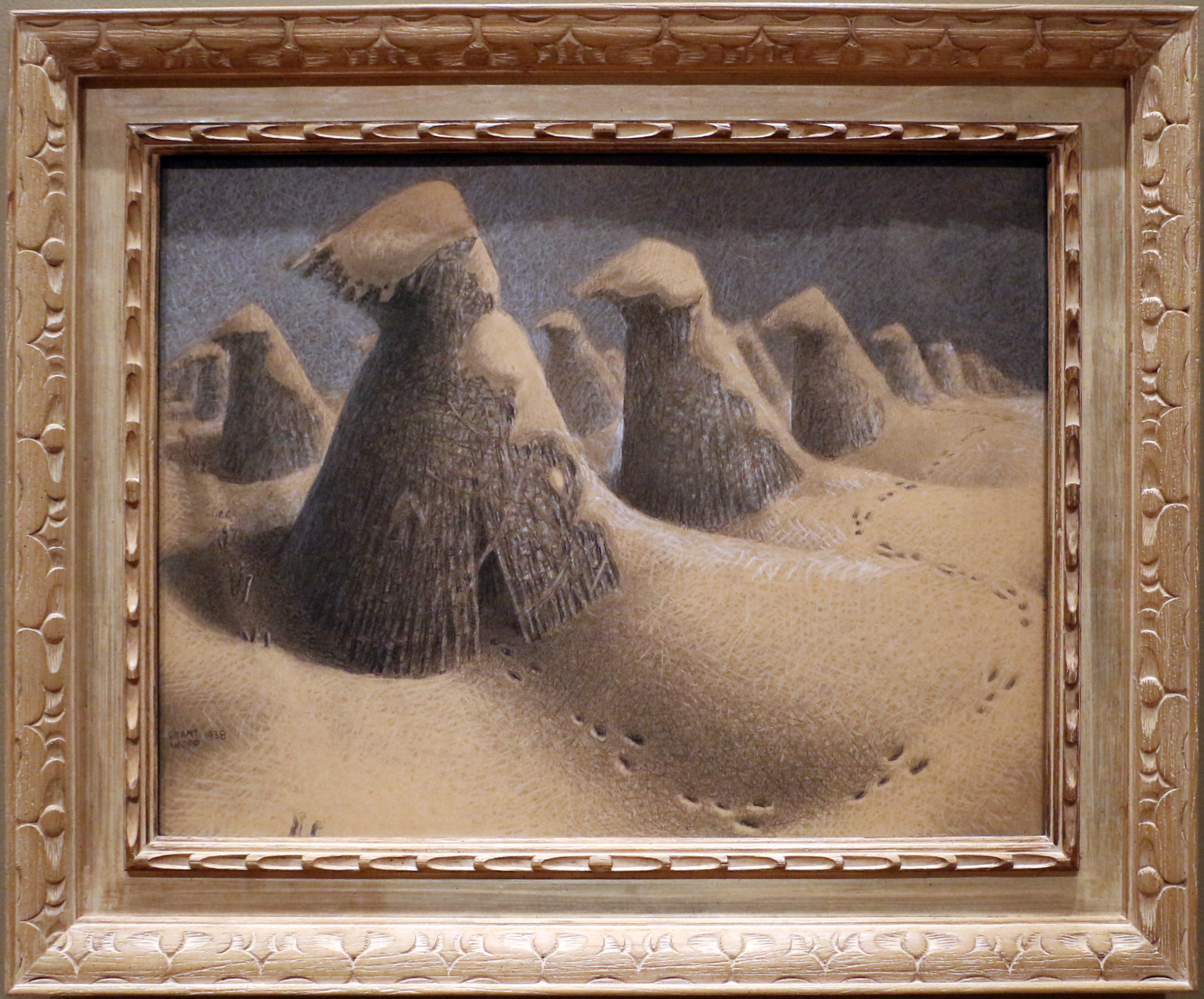
Grant Wood is most closely associated with the rural American Midwest, but Chicago was an important stop in his development as an artist. From 1913 through 1916, he studied at the School of the Art Institute of Chicago, adding formal training to an early working life that had already included a metal-shop apprenticeship and study at a Minneapolis art school.
That Chicago connection offers a useful way to look at Wood’s career: his later reputation was built around images of Midwestern life, yet his education crossed several settings and disciplines. Born in rural Iowa in 1891, Wood moved with his family to Cedar Rapids after his father died in 1901. He then worked in metal before pursuing art more fully. At the Handicraft Guild in Minneapolis, an art school run entirely by women, he enrolled in 1910. His time in Chicago followed that experience and included work as a silversmith.
Wood became a representative of Regionalism, a movement associated in this account with paintings depicting the rural Midwest. His best-known work is American Gothic, painted in 1930. The painting has since become an iconic example of early 20th-century American art, helping make Wood a lasting reference point for representations of the region.
The Chicago portion of his biography is brief in the available record, but it places the city within a broader sequence of artistic preparation. Wood arrived at the School of the Art Institute after early exposure to craft and design, rather than as someone whose career began with a single medium or institution. His later work is often remembered for its Midwestern subject matter; his training, however, included experiences in Iowa, Minneapolis and Chicago.
His career also included public service during World War I. Near the end of the war, he joined the army and worked as an artist, designing camouflage scenes and other art. From 1919 to 1925, he taught art to junior students, according to the supplied account.
For Chicago readers, Wood’s biography is therefore less a story of a Chicago-born artist than of a nationally recognized painter whose path passed through the city’s art-school world. The Art Institute years came before the 1930 painting that would define his public image, making Chicago part of the prehistory of one of American art’s most recognizable regionalist figures.
Source and reuse information This automatically generated backgrounder adapts text from “Grant Wood” on Wikipedia: https://en.wikipedia.org/wiki/Grant_Wood The adapted text is released under the Creative Commons Attribution-ShareAlike 4.0 International license (CC BY-SA 4.0): https://creativecommons.org/licenses/by-sa/4.0/. The source article’s linked references are provided below where available. This story has not been independently reviewed or fact-checked.
Further links listed by the Wikipedia page (not independently checked): - https://web.archive.org/web/20080708193645/http://www.grantwoodstudio.org/index.html - https://web.archive.org/web/20110505224913/http://www.lib.iastate.edu/info/6292 - https://viaf.org/viaf/92909902 - https://d-nb.info/gnd/118807846 - https://www.getty.edu/vow/ULANFullDisplay?find=&role=&nation=&subjectid=500031056 - https://rkd.nl/en/explore/artists/85497 Image rights Photograph description: European drawings in the Art Institute of Chicago Creator: Sailko. License: CC BY 3.0 (https://creativecommons.org/licenses/by/3.0). Original image page: https://commons.wikimedia.org/wiki/File%3AGrant_wood%2C_gennaio%2C_1938.jpg. The image was resized for display; no other changes were made.