LGBTQ+ · Chicago
Chicago-Born Scholar David M. Halperin Helped Shape Queer Studies
David M. Halperin, born in Chicago in 1952, became a prominent scholar of sexuality, gender and queer theory and helped establish the field’s academic infrastructure.
By KLGBT News Desk ·
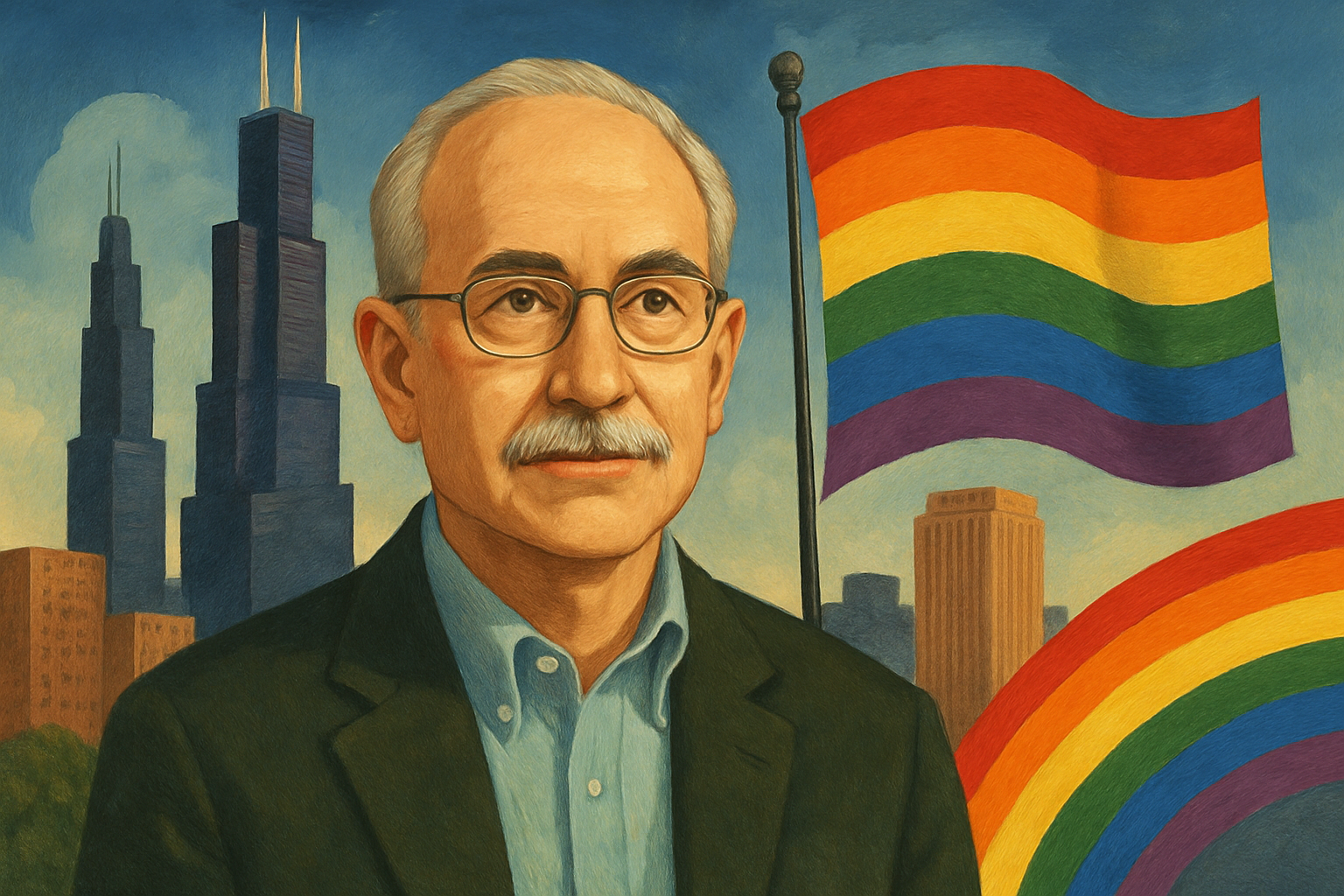
David M. Halperin’s path into queer theory began in Chicago, where he was born on April 2, 1952. He later became an influential scholar whose work connected the study of sexuality with classics, critical theory, material culture and visual culture.
Halperin graduated from Oberlin College in 1973. During his undergraduate years, he studied abroad at the Intercollegiate Center for Classical Studies in 1972 and 1973. He earned a doctorate in Classics and Humanities from Stanford University in 1980.
His scholarship has examined how same-sex desire and sexual identities are understood across history and culture. Among his books are “Before Pastoral,” published in 1983, and “One Hundred Years of Homosexuality,” published in 1990. The latter’s title reflects Halperin’s interest in questioning the assumption that modern categories of sexual identity can be applied unchanged to earlier societies.
Halperin also played a role in building institutions for lesbian and gay scholarship. He was a cofounder of “GLQ: A Journal of Lesbian and Gay Studies,” an academic publication devoted to research in the field. In 1989, he was among the first co-chairs, alongside Tina Passman, of the Lesbian and Gay Classical Caucus. That organization is now known as the Lambda Classical Caucus.
His academic career included a long period at the Massachusetts Institute of Technology, where he served as a professor of literature from 1981 through 1996. He also taught internationally, including at the University of Queensland in 1994 and Monash University in 1995. Earlier, in 1977, he served as associate director of the summer session of the School of Classical Studies at the American Academy in Rome.
For Chicago’s LGBTQ community, Halperin’s biography offers a local point of entry into the history of queer scholarship. His career illustrates how research into ancient texts, literature and visual culture became part of a broader effort to study sexual identities and challenge conventional accounts of gender and sexuality. His work also reflects the importance of professional networks and publications created by lesbian and gay scholars during the development of queer studies as an academic field.
Although much of Halperin’s career unfolded outside Illinois, his Chicago birth is an important part of the story of a scholar whose work helped give LGBTQ studies a lasting presence in universities and intellectual life.
Source and reuse information This backgrounder adapts factual material from “David M. Halperin” on Wikipedia: https://en.wikipedia.org/wiki/David_M._Halperin The adapted text is released under the Creative Commons Attribution-ShareAlike 4.0 International license (CC BY-SA 4.0): https://creativecommons.org/licenses/by-sa/4.0/. This story has not been independently reviewed or fact-checked.
Further links listed by the Wikipedia page (not independently checked): - https://viaf.org/viaf/7404054 - https://www.idref.fr/028407180 - https://id.ndl.go.jp/auth/ndlna/00513701 - https://d-nb.info/gnd/134100867 - https://authority.bibsys.no/authority/rest/authorities/html/90227539 - https://catalogue.bnf.fr/ark:/12148/cb12024823p Image rights Original illustrative artwork created from story keywords. It is illustrative, not a documentary photograph.