LGBTQ+ · Chicago
Chicago’s LGBTQ Neighborhoods Reflect a Century of Community and Change
From 1920s nightlife near the Water Tower to the modern gayborhoods of the North Side, Chicago’s LGBTQ history has been shaped by movement, visibility and debate over who those spaces serve.
By KLGBT News Desk ·
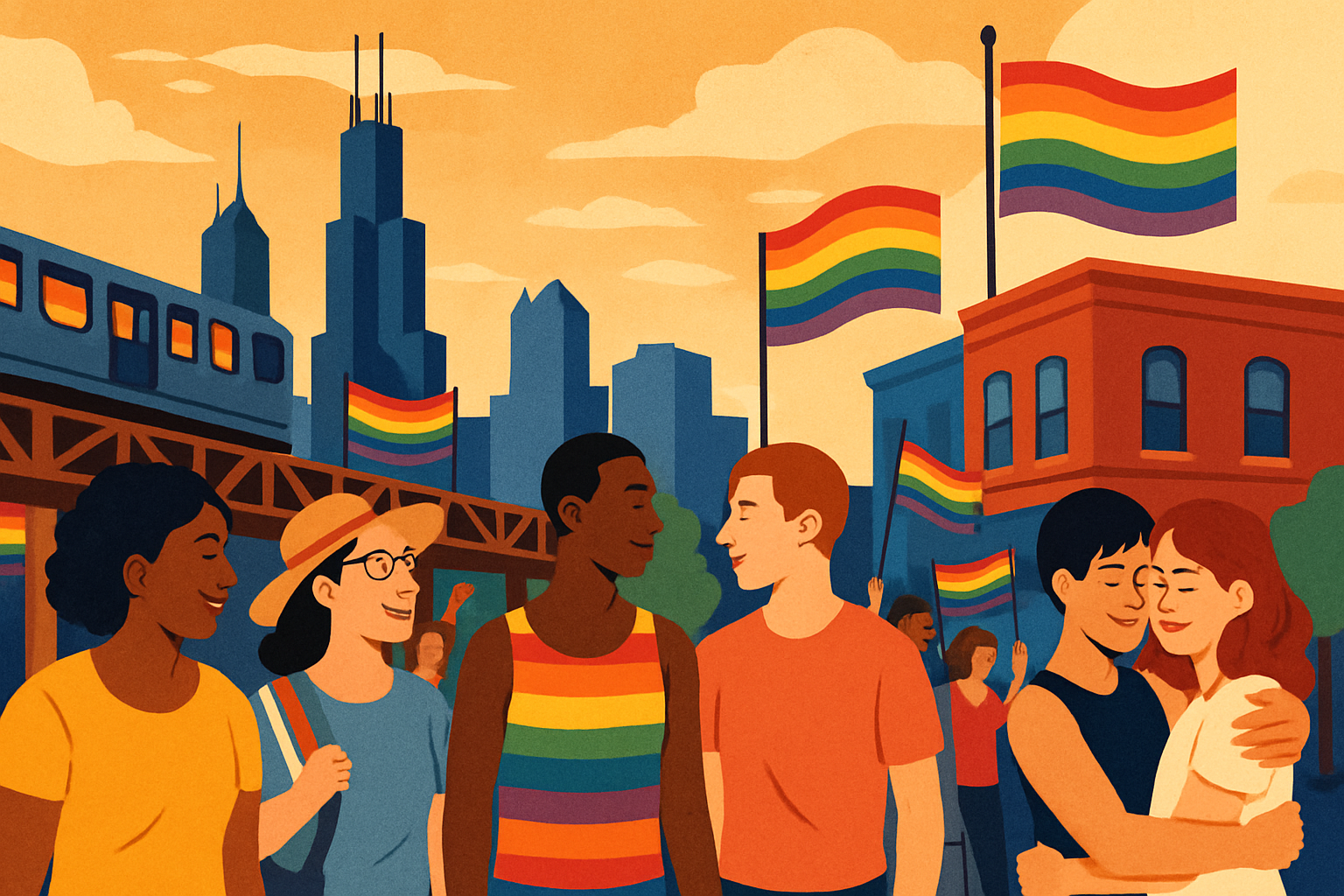
Chicago’s LGBTQ community has long played a major role in the city’s cultural life and in the broader history of gay rights in the United States. With a population of roughly 3 million people, the city is home to an estimated 150,000 residents who identify as lesbian, bisexual, gay, transgender, questioning or another LGBTQ+ identity.
That community’s geography has changed significantly over time. LGBTQ nightlife was already established in Towertown, near the Water Tower, during the 1920s. As rents rose in the middle of the 20th century, gay-friendly businesses and gathering places gradually moved north. The pattern took them through Old Town and Lincoln Park, largely along Clark Street, before reaching the area now widely known as Boystown.
Boystown remains Chicago’s most recognizable LGBTQ neighborhood and one of the city’s best-known centers of queer culture. Its visibility has helped make Chicago a major LGBTQ destination in the Midwest, alongside communities in New York City and San Francisco. The neighborhood’s prominence, however, has also prompted criticism about representation and access.
In recent years, some community members and observers have argued that Boystown has increasingly catered to affluent white gay men rather than reflecting the full breadth of Chicago’s LGBTQ population. That criticism points to a larger question facing established LGBTQ districts: how can a neighborhood retain its cultural importance while serving people across identities, races, gender expressions and economic backgrounds?
Gentrification has also affected where LGBTQ Chicagoans live. As costs and neighborhood conditions have changed, many LGBTQ residents have moved farther north, including to Uptown, Edgewater and Rogers Park. These shifts show that LGBTQ culture in Chicago is not confined to one district, even though Boystown remains its most visible symbol.
The city’s history therefore includes both continuity and transition. LGBTQ spaces have persisted for generations, but their locations and social roles have evolved as housing costs, development and community priorities changed. From early nightlife near the Water Tower to a broader network of North Side neighborhoods, Chicago’s LGBTQ geography reflects the community’s endurance as well as ongoing debates about belonging, visibility and who gets to shape queer cultural spaces.
Source and reuse information This backgrounder adapts factual material from “LGBTQ culture in Chicago” on Wikipedia: https://en.wikipedia.org/wiki/LGBTQ_culture_in_Chicago The adapted text is released under the Creative Commons Attribution-ShareAlike 4.0 International license (CC BY-SA 4.0): https://creativecommons.org/licenses/by-sa/4.0/. This story has not been independently reviewed or fact-checked.
Further links listed by the Wikipedia page (not independently checked): - https://books.google.com/books?id=2FBkJEVLio8C&pg=PA43 - https://books.google.com/books?id=DCILcKYEg-gC&pg=PT103 - https://web.archive.org/web/20101205015304/http://chicago.gopride.com/ - https://books.google.com/books?id=m_boGY8AUTIC&pg=PA145 - https://www.chicagotribune.com/news/local/breaking/ct-pride-parade-aftermath-met-20150629-story.html - https://web.archive.org/web/20140107123916/http://www.cityofchicago.org/city/en/depts/cdph/supp_info/lgbt/lgbt_community_actionplan.html Image rights Original illustrative artwork created from story keywords. It is not a documentary photograph.