Politics · Chicago
Jane Addams and the Chicago Institution That Reshaped Social Reform
Jane Addams helped make Chicago a national center for settlement work, social reform, and the emerging profession of social work through Hull House.
By KLGBT News Desk ·
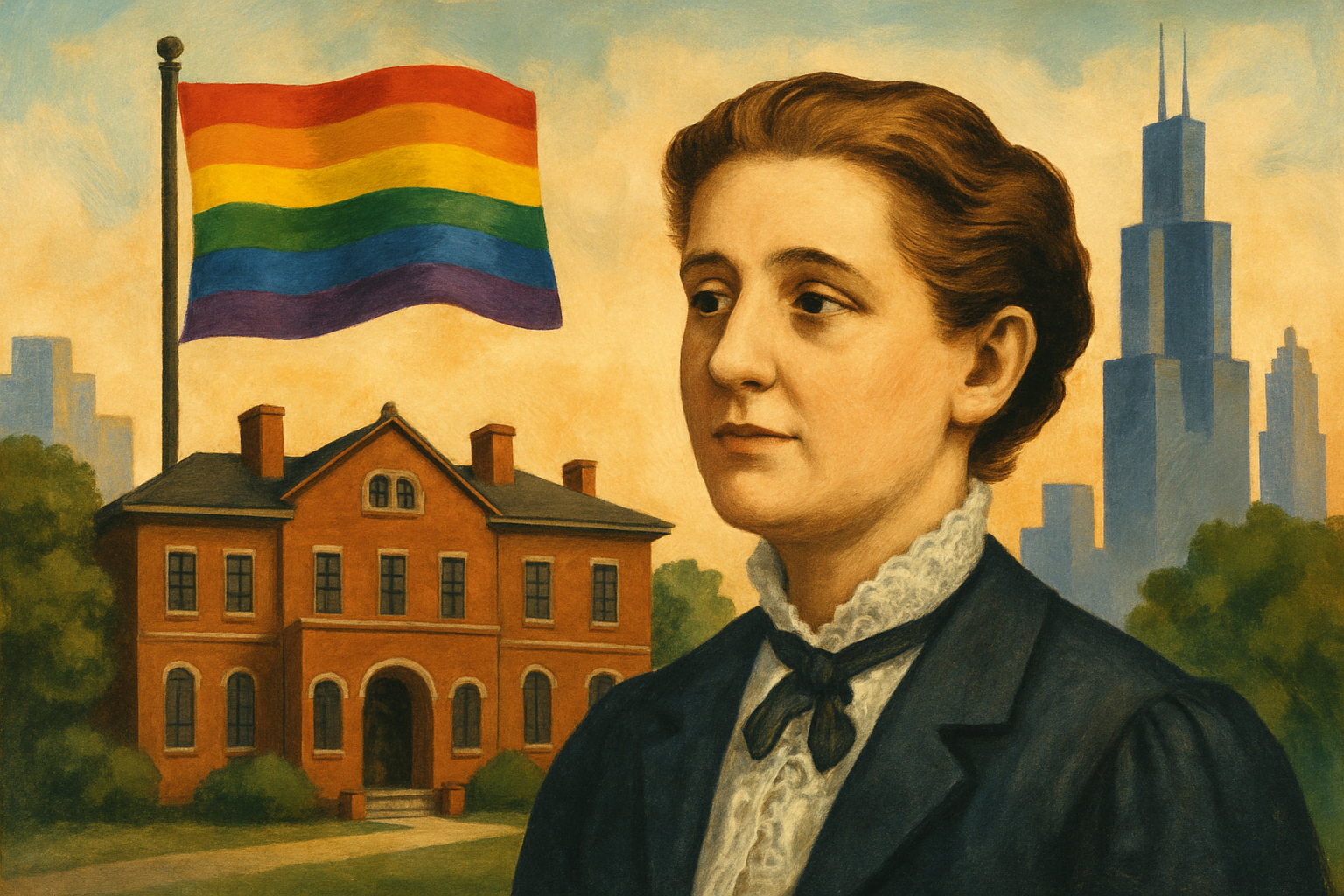
Chicago’s history of organized social service is closely linked to Jane Addams, the reformer who co-founded Hull House in 1889. The settlement house became one of the best-known institutions of its kind in the United States, offering broad assistance to poor families, many of them immigrants living in the city.
Addams’s work placed direct community service at the center of public debate. Hull House was not simply a charitable project; it reflected her belief that social problems required sustained civic attention and practical reform. Through that work, she became a major figure in the development of social work in the United States and in the broader reform movements of the Progressive Era.
Born in 1860, Addams worked across several fields. She was an activist, author, philosopher, sociologist, public administrator, and advocate for women’s suffrage. Her approach was grounded in what is described as radical pragmatism: an emphasis on ideas tested through public life and community action. That combination helped make her one of the period’s most prominent reformers, at a time when political leaders were also presenting themselves as agents of social change.
Her influence extended beyond Chicago. Addams advocated for international peace and became the first American woman to receive the Nobel Peace Prize, sharing the 1931 award with Nicholas Murray Butler. The recognition reflected the international reach of a career that began with neighborhood-based work and grew into a national and global reform legacy.
Addams also challenged the boundaries of American intellectual and educational institutions. She has been described as arguably the country’s first woman public philosopher. In 1910, Yale University awarded her an honorary Master of Arts degree, making her the first woman to receive an honorary degree from the school.
For Chicago, however, Hull House remains the central part of her legacy. Its creation showed how a local institution could respond to the needs of immigrant and low-income residents while also influencing national debates over democracy, poverty, labor, education, and public responsibility. Addams’s career connected those neighborhood concerns to larger campaigns for peace, women’s political participation, and social reform.
Her story remains significant because it places Chicago at the center of a formative chapter in American social work. Addams did not separate intellectual life from civic action. She treated the city itself as a place where reform ideas could be tested, built through institutions, and made accountable to the people they were intended to serve.
Source and reuse information This backgrounder adapts factual material from “Jane Addams” on Wikipedia: https://en.wikipedia.org/wiki/Jane_Addams The adapted text is released under the Creative Commons Attribution-ShareAlike 4.0 International license (CC BY-SA 4.0): https://creativecommons.org/licenses/by-sa/4.0/. This story has not been independently reviewed or fact-checked.
Further links listed by the Wikipedia page (not independently checked): - https://web.archive.org/web/20090515215314/http://www.wilpf.int.ch/history/hindex.htm - https://web.archive.org/web/20070716215725/http://www.illinoistollway.com/portal/page?_dad=portal&_schema=PORTAL&_pageid=133,1395269 - https://web.archive.org/web/20151017032241/http://www.glhalloffame.org/index.pl?page=inductees&todo=year - https://www.academia.edu/6310490/ - https://archive.org/details/hullhousemapsan00unkngoog - https://archive.org/details/democracyandsoc04addagoog Image rights Original illustrative artwork created from story keywords. It is illustrative, not a documentary photograph.