LGBTQ+ · Chicago
Remembering the 1964 Fun Lounge Raid Near Chicago
A raid at Louie’s Fun Lounge near O’Hare led to 109 arrests and remains a significant episode in the LGBTQ history of the Chicago area.
By KLGBT News Desk ·
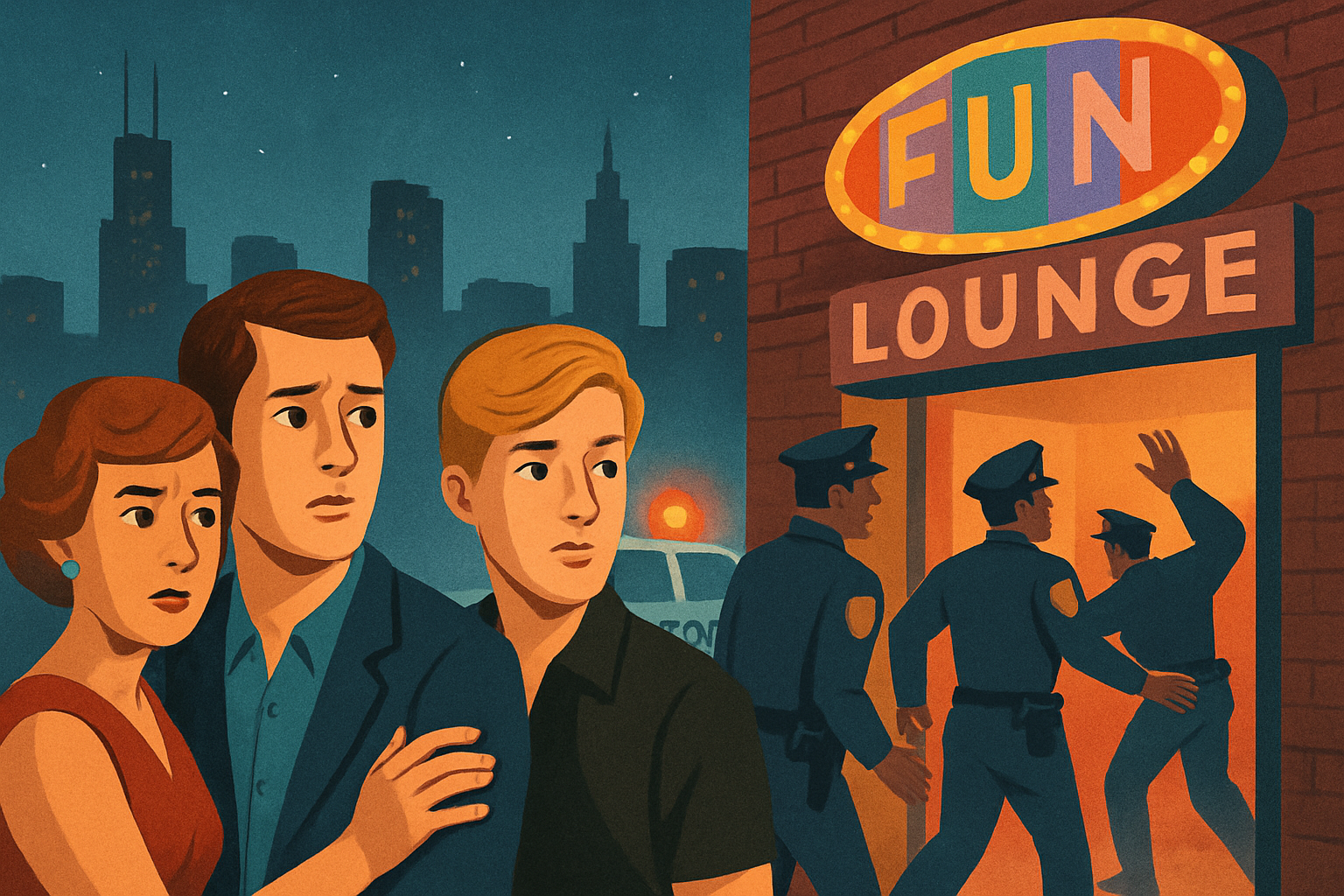
Before Chicago’s LGBTQ nightlife became more visible and established, gay bars across the metropolitan area operated under constant pressure from law enforcement and public hostility. Louie’s Fun Lounge, located on Mannheim Road near O’Hare International Airport, was one of those gathering places. Although it stood outside Chicago, the club was part of the region’s LGBTQ social world.
In the early morning of April 25, 1964, Cook County sheriff’s deputies raided the Fun Lounge. The operation resulted in the arrest of 109 people, making it a major law-enforcement action against a gay venue in the area. Deputies also seized illegal drugs valued at several hundred dollars.
The raid took place during a period when police actions against gay bars were common. These establishments offered some of the few public spaces where LGBTQ people could meet, socialize and form community, but their existence also made them vulnerable to official scrutiny. A raid could carry consequences well beyond an arrest. People taken into custody risked having their names and personal information printed in newspapers, exposing them to possible damage at work and in their personal relationships.
That possibility made police raids especially threatening for people whose sexual identities were not publicly known. The press coverage surrounding such actions could turn a night at a club into a lasting personal crisis, even for people who faced no further legal consequences. The broader pattern reflected the homophobia that shaped public institutions and everyday life in the United States during the mid-20th century.
The Fun Lounge raid is remembered not simply as a police action, but as part of the history of how LGBTQ people in and around Chicago found one another in an era of discrimination. The club’s location near a major airport and outside the city limits also illustrates the geographic reach of the region’s LGBTQ nightlife. Community life was not confined to Chicago’s municipal boundaries; people traveled across the metropolitan area to reach bars and other gathering places.
More than six decades later, the 1964 raid remains a notable episode in local LGBTQ history. Its scale—109 arrests—underscores the vulnerability of gay bars and their patrons at the time. Remembering the Fun Lounge helps document both the risks faced by LGBTQ people seeking community and the importance of the spaces where that community formed.
Source and reuse information This backgrounder adapts factual material from “Fun Lounge police raid” on Wikipedia: https://en.wikipedia.org/wiki/Fun_Lounge_police_raid The adapted text is released under the Creative Commons Attribution-ShareAlike 4.0 International license (CC BY-SA 4.0): https://creativecommons.org/licenses/by-sa/4.0/. This story has not been independently reviewed or fact-checked.
Further links listed by the Wikipedia page (not independently checked): - https://books.google.com/books?id=sMAhAwAAQBAJ - https://books.google.com/books?id=44lheqlq-jYC - https://books.google.com/books?id=qJZdHuZ0aM0C - https://books.google.com/books?id=aiYz7ArJt_AC - https://chicago.suntimes.com/2019/6/27/18760194/stonewall-anniversary-chicago-pride-parade-events-lgbtq - https://beltmag.com/queer-resistance-stonewall/ Image rights Original illustrative artwork created from story keywords. It is illustrative, not a documentary photograph.