Beyond the Bay · Jacksonville
African American History in Jacksonville Begins With Florida’s Early Colonial Era
Jacksonville’s African American history reaches back to the earliest European settlements in Florida, with Africans present in the region’s colonial history and African Americans later contributing substantially to the city’s development.
By KLGBT News Desk ·
The history of African Americans in Jacksonville is connected to the earliest European efforts to establish permanent settlements in Florida. The story begins before Jacksonville existed as a city, in a period when European expeditions were exploring the St. Johns River and competing for control of the region.
In 1562, French Huguenot explorer Jean Ribault traveled along the St. Johns River and encountered the Timucuan people. Ribault and other French Huguenots constructed Fort Caroline near St. Johns Bluff as part of an effort to establish a lasting French presence in Florida.
Three years later, Spanish forces led by Pedro Menéndez de Avilés founded St. Augustine. The settlement became a base for attacking Fort Caroline, which was under French control. The Spanish victory brought Florida under Spanish control and shaped the colonial setting in which African people were already present.
The National Park Service has documented that both free and enslaved Africans accompanied the Spanish. Their labor supported the construction and operation of the early settlement. They worked on fortifications, cut timber, built churches, constructed a blacksmith shop and an artillery platform, and cleared land for agriculture.
This account places Africans within the region’s earliest documented colonial development rather than treating African American history as a later addition to Jacksonville’s story. The work described in the historical record included skilled construction, land clearing and other essential tasks that helped establish the physical foundations of Spanish Florida.
The source also notes that Spanish ideas about slavery drew on beliefs associated with ancient Rome and had been codified in the 13th-century Siete Partidas. That legal and ideological background formed part of the system under which enslaved Africans were brought to and used in colonial Florida.
Jacksonville’s African American history therefore reaches across several layers of the region’s past: Indigenous presence along the St. Johns River, French and Spanish colonial competition, the arrival of free and enslaved Africans, and the labor that supported early settlements. The history is also part of Jacksonville’s present civic context. According to the U.S. Census Bureau figure cited in the source, African Americans make up 30.7 percent of the city’s population.
Taken together, these points offer a long-view introduction to African American contributions in Jacksonville. They show that African presence in the wider area dates to the colonial period and that African labor was involved in building institutions and infrastructure associated with Florida’s earliest European settlements.
Source and reuse information This automatically generated backgrounder adapts text from “History of African Americans in Jacksonville” on Wikipedia: https://en.wikipedia.org/wiki/History_of_African_Americans_in_Jacksonville The adapted text is released under the Creative Commons Attribution-ShareAlike 4.0 International license (CC BY-SA 4.0): https://creativecommons.org/licenses/by-sa/4.0/. The source article’s linked references are provided below where available. This story has not been independently reviewed or fact-checked.
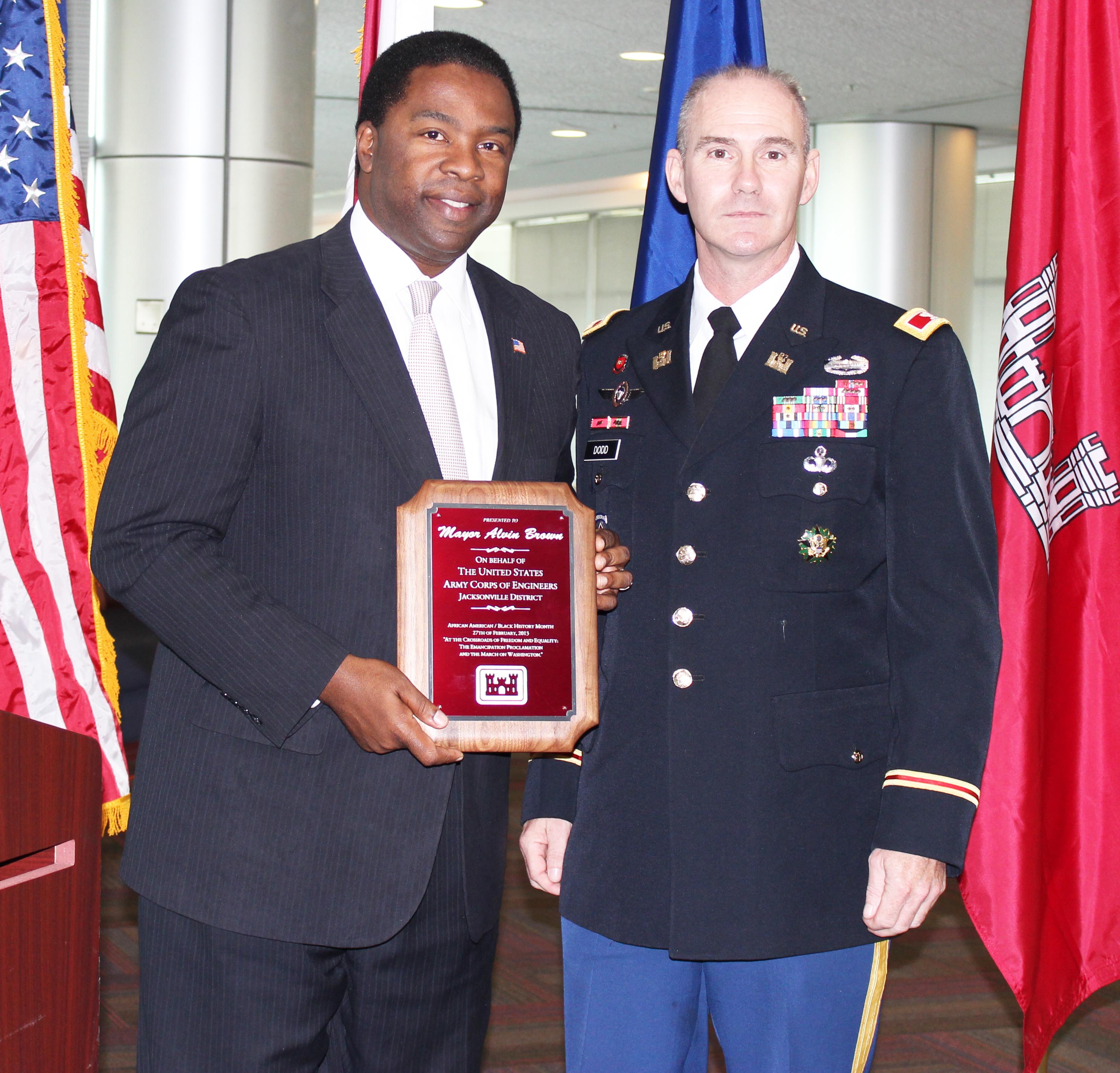
Further links listed by the Wikipedia page (not independently checked): - https://www.census.gov/quickfacts/fact/table/jacksonvillecityflorida,US/PST045219 - https://www.legendsofamerica.com/fl-staugustine/ - https://www.nps.gov/casa/learn/historyculture/african-americans-in-st-augustine-1565-1821.htm - https://www.jstor.org/stable/23264716 - https://www.washingtonpost.com/history/2020/08/27/axe-handle-saturday-klan-attack-civil-rights-protesters/ - https://www.jstor.org/stable/25163192 Image rights Photograph description: Col. Alan Dodd (right), district commander, presented a plaque to Jacksonville Mayor Alvin Brown to thank him for his participation in the Black History Month closing ceremony Feb. 27. Brown is the first African American mayor of Jacksonville, and has made military affairs a priority for his administration. (Photo by Christina Swanson) <a href=" http://www.saj.usace.army.mil/Media/NewsStories/tabi Creator: JaxStrong. License: CC BY 2.0 (https://creativecommons.org/licenses/by/2.0). Original image page: https://commons.wikimedia.org/wiki/File%3AJacksonville_Mayor_celebrates_Black_History_Month_with_Corps_Employees_(8567773041).jpg. The image was resized for display; no other changes were made.