Culture · Jacksonville
Treaty Oak: Jacksonville’s Living Landmark
In Downtown Jacksonville’s Southbank, an estimated 250-year-old live oak anchors Treaty Oak Park and carries a name rooted in a 1930s effort to save it from development.
By KLGBT News Desk ·
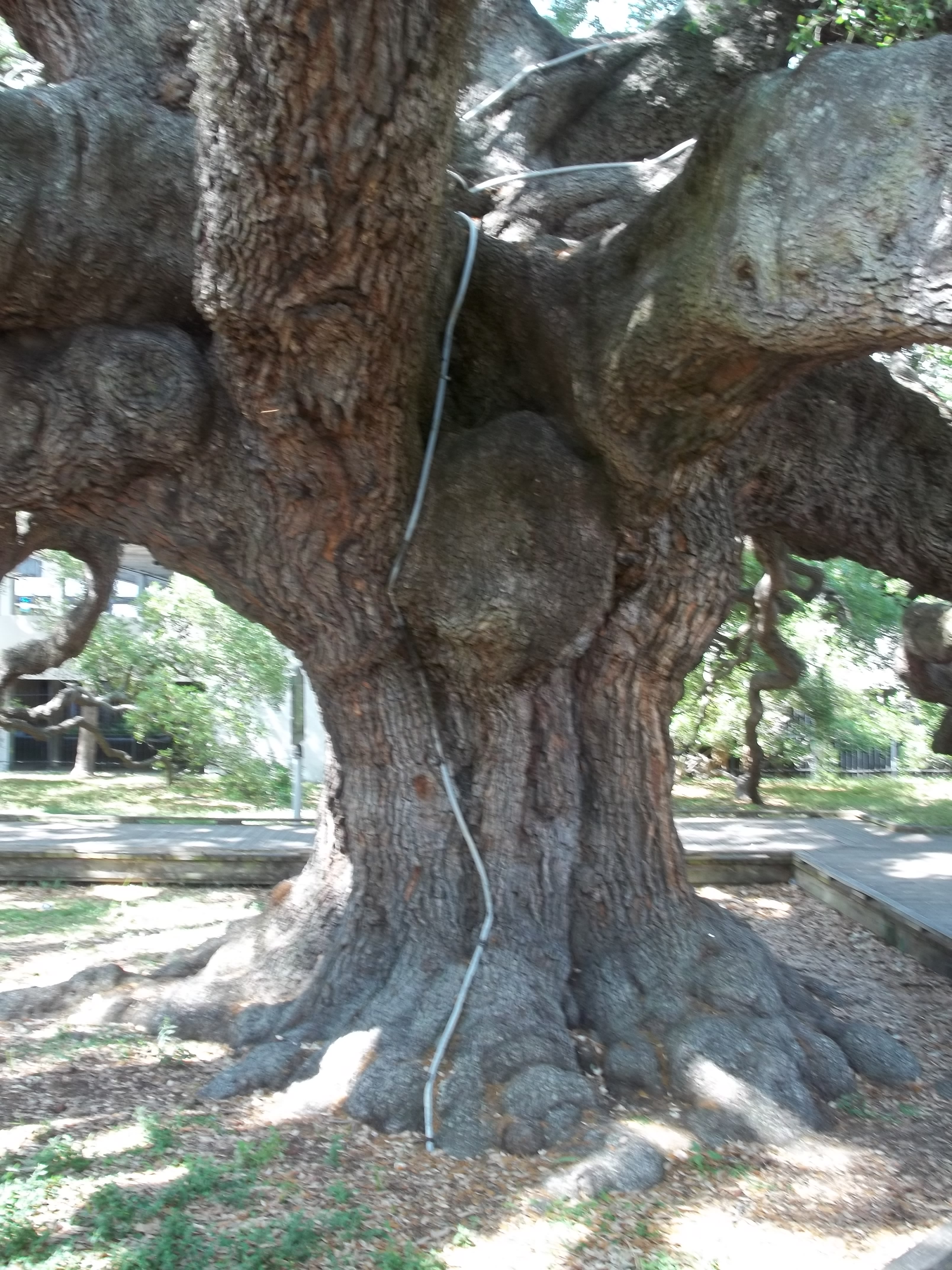
Treaty Oak is one of Jacksonville’s most distinctive natural landmarks: a southern live oak with an expansive, twisting form in Treaty Oak Park, in the Southbank area of Downtown Jacksonville.
Estimated to be about 250 years old, the tree may be the oldest living thing in the city. Its age places it in the landscape before Jacksonville was founded by Isaiah Hart during the 1820s, giving the oak a history that reaches beyond the city’s formal beginnings.
The tree’s physical scale helps explain its prominence. Its trunk measures more than 25 feet around, while the oak rises approximately 70 feet. Its crown extends across more than 145 feet, and its branches twist downward toward the ground before curling upward again. Together, the limbs shade a roughly circular area measuring about 190 feet across.
The name Treaty Oak is connected to stories about supposed peace agreements between Native Americans and Spanish or American settlers. Those accounts are described as apocryphal rather than established history. The name itself emerged in the 1930s through the work of Pat Moran, a journalist with the Florida Times-Union.
Moran used the story as part of an effort to protect the tree from developers. In an article, he presented the claim that a treaty had been signed beneath the oak by Indigenous Floridians and early European settlers, and he gave the tree the name it carries today. Before then, Jacksonville residents reportedly knew it simply as Giant Oak.
That history makes Treaty Oak notable for more than its age or size. Its public identity was shaped not only by the tree’s long life, but also by a newspaper-created narrative intended to draw attention to its possible destruction. The result is a landmark whose story combines urban development, local journalism and the changing ways communities preserve places.
Today, Treaty Oak Park provides the setting for the tree in the Southbank district. The oak’s broad canopy and unusual, octopus-like structure distinguish it from an ordinary street tree, while its estimated age connects the contemporary city to a much earlier landscape.
For Jacksonville residents and visitors, Treaty Oak offers a reminder that the city’s history is not limited to buildings, institutions or founding dates. It can also be read in a living organism that predates Jacksonville’s establishment and whose name reflects an old story, a modern act of advocacy and the power of place-based memory.
Source and reuse information This automatically generated backgrounder adapts text from “Treaty Oak (Jacksonville)” on Wikipedia: https://en.wikipedia.org/wiki/Treaty_Oak_(Jacksonville) The adapted text is released under the Creative Commons Attribution-ShareAlike 4.0 International license (CC BY-SA 4.0): https://creativecommons.org/licenses/by-sa/4.0/. The source article’s linked references are provided below where available. This story has not been independently reviewed or fact-checked.
Further links listed by the Wikipedia page (not independently checked): - https://web.archive.org/web/20120427225553/http://apps2.coj.net/parksinternet/parkdetails.asp?parkid=70 - https://geohack.toolforge.org/geohack.php?pagename=Treaty_Oak_(Jacksonville)¶ms=30.3170_N_81.6581_W_type:landmark Image rights Photograph description: Jacksonville, Florida : Treaty Oak Creator: Ebyabe. License: CC BY-SA 4.0 (https://creativecommons.org/licenses/by-sa/4.0). Original image page: https://commons.wikimedia.org/wiki/File%3AJax_FL_Treaty_Oak05.jpg. The image was resized for display; no other changes were made.