LGBTQ+ · Los Angeles
Before Stonewall, Los Angeles’s Knights of the Clock Built Community Across Racial Lines
The Knights of the Clock was an early Los Angeles LGBTQ organization that combined social gatherings with practical support for interracial same-sex couples.
By KLGBT News Desk ·
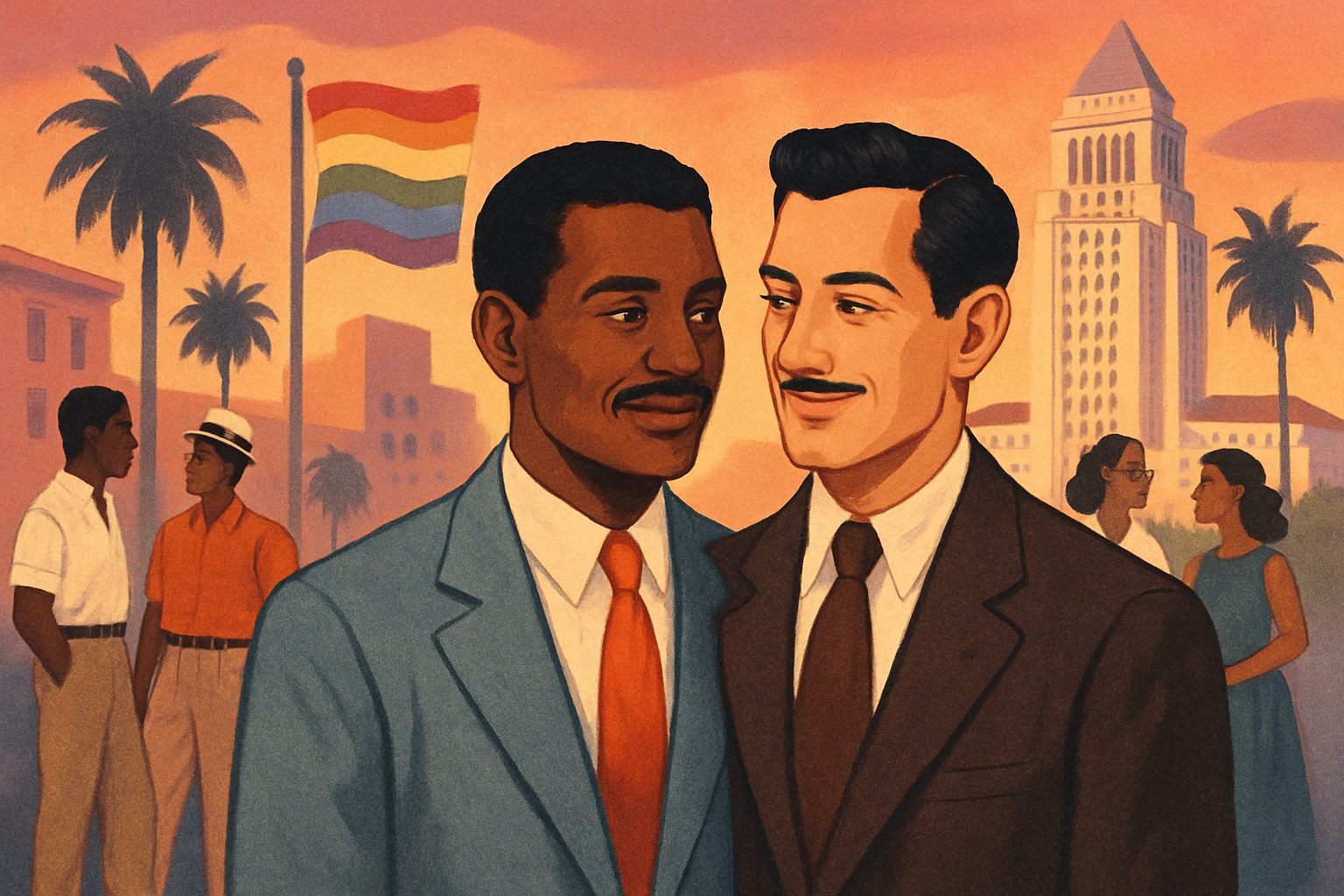
Long before LGBTQ organizations became widely visible in American public life, Los Angeles was home to a group that made room for interracial same-sex couples and their families. Known as the Knights of the Clock, the organization was an interracial homophile social club whose activities went beyond hosting parties.
The group’s formal name was the Cloistered Order of Conclaved Knights of Sophisticracy. It was founded by Merton Bird, an African-American man, and W. Dorr Legg, his white lover. Historical sources do not agree on the precise year the organization began, identifying 1949, 1950 or 1951. Even with that uncertainty, the Knights belong to the earliest generation of gay organizations in the United States.
Only a small number of groups are generally identified as predating the Knights. These include the Society for Human Rights, founded in 1924, and the Veterans Benevolent Association, founded in 1945. The Mattachine Society, established in 1950, may also have come earlier, depending on which founding date is used for the Knights.
The Knights were chiefly a social organization. Its membership and gatherings included people of both sexes, as well as family members connected to couples. At a time when same-sex relationships could face intense social and practical barriers, creating a setting where couples and relatives could meet was itself a significant form of support.
The group also took on problems that specifically affected interracial couples. Members discussed employment counseling and efforts to find integrated housing for same-sex couples. Those concerns linked the organization’s social purpose to the everyday challenges of finding work and a home without separating couples along racial lines.
Another idea that remained part of the Knights’ discussions was the creation of communes. The organization considered establishing such communities throughout its existence, but no communes were ultimately formed.
The scale of the group’s social events suggests that the Knights offered more than a private circle of a few friends. Gatherings could draw as many as 200 people, according to the historical account. That reach placed the organization within Los Angeles’s early LGBTQ history as both a social network and a venue for mutual assistance.
The Knights’ story also complicates familiar timelines of LGBTQ organizing. National histories often emphasize organizations that became better known, but Los Angeles had its own early institution addressing sexuality, race, relationships and family life together. The surviving record, including disagreement over the founding year, may be incomplete. Still, the Knights of the Clock stand as an important example of Angelenos creating community and practical support under conditions that made both difficult.
Source and reuse information This backgrounder adapts factual material from “Knights of the Clock” on Wikipedia: https://en.wikipedia.org/wiki/Knights_of_the_Clock The adapted text is released under the Creative Commons Attribution-ShareAlike 4.0 International license (CC BY-SA 4.0): https://creativecommons.org/licenses/by-sa/4.0/. This story has not been independently reviewed or fact-checked. Image rights Original illustrative artwork created from story keywords. It is not a documentary photograph.