LGBTQ+ · Los Angeles
Before Stonewall’s Legacy Took Shape, Wilmington’s Patch Challenged Police Harassment
The Patch, a former gay bar on Wilmington’s Pacific Coast Highway, became an early Los Angeles site of resistance to police demands targeting LGBTQ patrons and performers.
By KLGBT News Desk ·
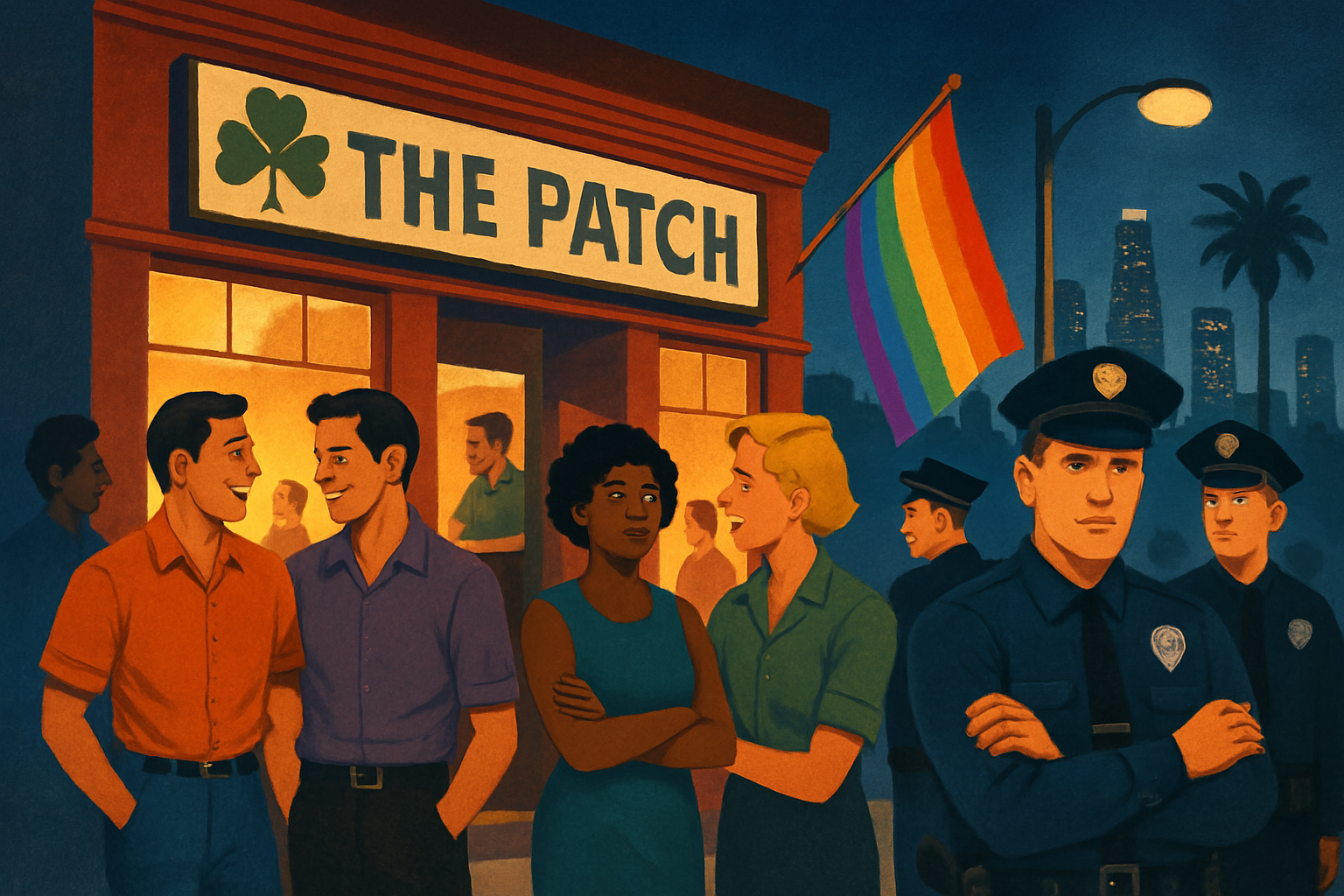
Long before LGBTQ rights victories reshaped public life, a bar in Wilmington became one of Southern California’s early sites of open resistance to police harassment. The Patch, formerly located at 610 W. Pacific Coast Highway, stood alongside the Black Cat Tavern as a pivotal gathering place in the region’s gay rights movement.
That resistance came in August 1968, when The Patch pushed back against rules and warnings imposed by the Los Angeles Police Department. The bar was owned and managed by comedian Lee Glaze, who was known in the local gay scene by his club name, “The Blond Darling.” Its clientele included gay men and women, among them many women connected to the local roller derby circuit.
According to the historical account, police repeatedly warned Glaze that the business could remain open only if it restricted ordinary forms of LGBTQ social life. The demands included banning drag performances, physical contact, male-to-male dancing and groping. Police also insisted that no more than one person at a time use the restrooms.
Glaze initially attempted to follow those directives. The restrictions, however, hurt business. Rather than allow the bar to disappear under the pressure, he developed a discreet way to alert customers when undercover officers were present: a particular song on the jukebox, “God Save the Queen.”
The signal turned the jukebox into a tool of collective awareness. Customers could recognize the warning and understand that police were inside the bar, creating a way for the community to respond to surveillance and intimidation while continuing to gather.
The Patch’s importance lies in the setting as much as the confrontation. It was not a distant political headquarters or a formal organization. It was a neighborhood bar where people came to socialize, dance and find one another at a time when police attention could threaten LGBTQ businesses and patrons. The account of the bar’s history places it among the first Southern California locations where there was open resistance to that ongoing harassment.
For Los Angeles, The Patch is part of a broader history that connects nightlife, community formation and civil rights activism. Its story also underscores how resistance could begin with practical decisions inside a local business: refusing to let discriminatory conditions determine who could perform, dance or gather. Though the Wilmington bar is no longer operating at its former Pacific Coast Highway location, its role remains tied to the early organizing and defiance that helped shape LGBTQ history in the region.
Source and reuse information This backgrounder adapts factual material from “The Patch (bar)” on Wikipedia: https://en.wikipedia.org/wiki/The_Patch_(bar) The adapted text is released under the Creative Commons Attribution-ShareAlike 4.0 International license (CC BY-SA 4.0): https://creativecommons.org/licenses/by-sa/4.0/. This story has not been independently reviewed or fact-checked.
Further links listed by the Wikipedia page (not independently checked): - https://archive.org/details/gaylahistoryofse00lill - https://books.google.com/books?id=T5GJ2j3_-OgC&q=our+god+too Image rights Original illustrative artwork created from story keywords. It is illustrative, not a documentary photograph.