LGBTQ+ · Los Angeles
BLK Magazine Put Los Angeles’ Black LGBTQ Community in Print
Published in Los Angeles, BLK began as a free local magazine for Black lesbians and gay men before growing into a national and international news publication.
By KLGBT News Desk ·
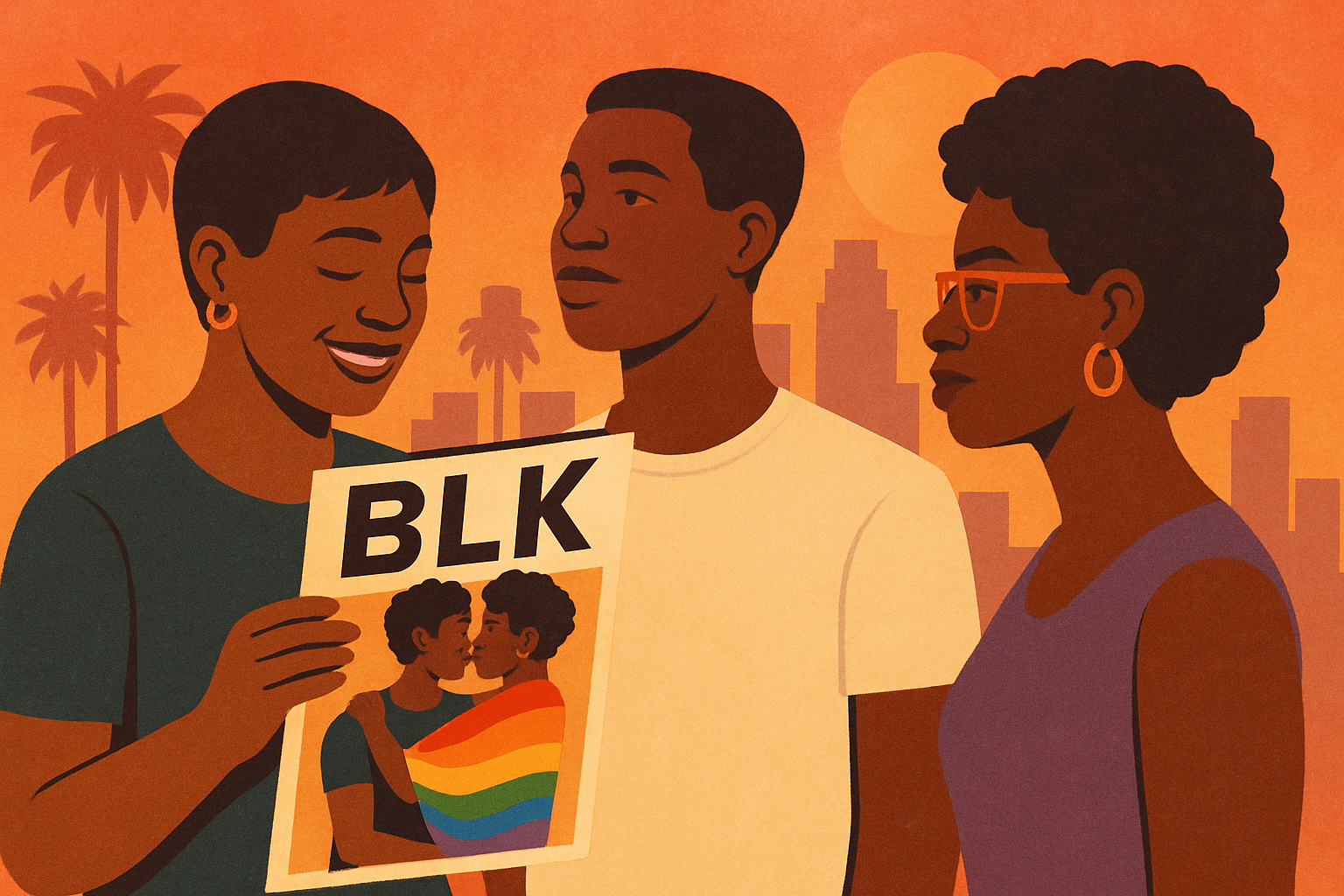
Before BLK became a publication with readers beyond Southern California, it served a more immediate purpose: creating a reliable source of news for Black lesbians and gay men in Los Angeles.
The monthly magazine was published in Los Angeles and initially circulated at Black-owned and Black-focused establishments frequented by local LGBTQ people. It was free, helping the publication reach readers through community spaces rather than relying only on conventional subscriptions or newsstands. Distribution soon widened to LGBT venues across Greater Los Angeles.
That local foundation shaped BLK’s identity. The magazine began by reporting on the Black LGBTQ scene around it, then broadened its coverage to address national and international issues. Its audience eventually extended across the United States and into Canada. Even as its geographic reach grew, its roots remained tied to Los Angeles and to the need for media that treated Black LGBTQ lives as a distinct and important subject.
The publication’s origins were closely connected to the HIV/AIDS crisis. Alan Bell, an African-American graphic designer who had previously published Gaysweek in New York City during the late 1970s, was encouraged to create a news magazine for Black lesbians and gay men. Among those urging him were Black LGBTQ HIV/AIDS activists, including Phill Wilson. Bell had initially been reluctant to return to publishing, but the lack of dependable print information for African-American LGBTQ communities—and the urgent information needs surrounding HIV—made the project difficult to ignore.
The magazine’s early connection to HIV outreach was also visible in Bell’s work at Black Jack, a safer-sex club for Black gay men in Los Angeles. That setting gave him a direct view of the information gap facing the community and the importance of communicating about health without separating it from culture, identity and local life.
BLK identified itself as a national Black lesbian and gay news magazine, but its path to that role started with neighborhood distribution. Its growth illustrates how LGBTQ media can develop from a local response into a broader institution: first by meeting readers where they are, then by carrying local experiences into national and international conversations.
For Los Angeles, BLK’s history is a reminder that the city’s LGBTQ press has not been one-size-fits-all. The magazine was designed specifically for Black readers whose stories and concerns were not being adequately served elsewhere. Its expansion did not erase that original mission; it demonstrated how a publication grounded in a particular community could speak to a much larger audience.
Source and reuse information This backgrounder adapts factual material from “BLK (magazine)” on Wikipedia: https://en.wikipedia.org/wiki/BLK_(magazine) The adapted text is released under the Creative Commons Attribution-ShareAlike 4.0 International license (CC BY-SA 4.0): https://creativecommons.org/licenses/by-sa/4.0/. This story has not been independently reviewed or fact-checked.
Further links listed by the Wikipedia page (not independently checked): - https://digitalarchives.broward.org/digital/collection/p16146coll20 - https://www.worldcat.org/search?fq=x0:jrnl&q=n2:1043-0075 - https://search.worldcat.org/issn/1043-0075 - https://www.autostraddle.com/black-queer-and-here-without-apology-the-history-of-blk-and-black-lace-magazines/ - https://www.gayemagazine.com/post/black-gaye-history-alan-bell-founder-of-the-first-nationally-distributed-black-gay-magazine-blk - https://www.instagram.com/blackfiremagazine/ Image rights Original illustrative artwork created from story keywords. It is not a documentary photograph.