Culture · Los Angeles
Rafa Esparza’s Los Angeles Practice Moves Between Body, Place and Inheritance
The Pasadena-born performance artist draws on Los Angeles histories, family knowledge and experimental performance traditions in work that spans live art, video and installation.
By KLGBT News Desk ·
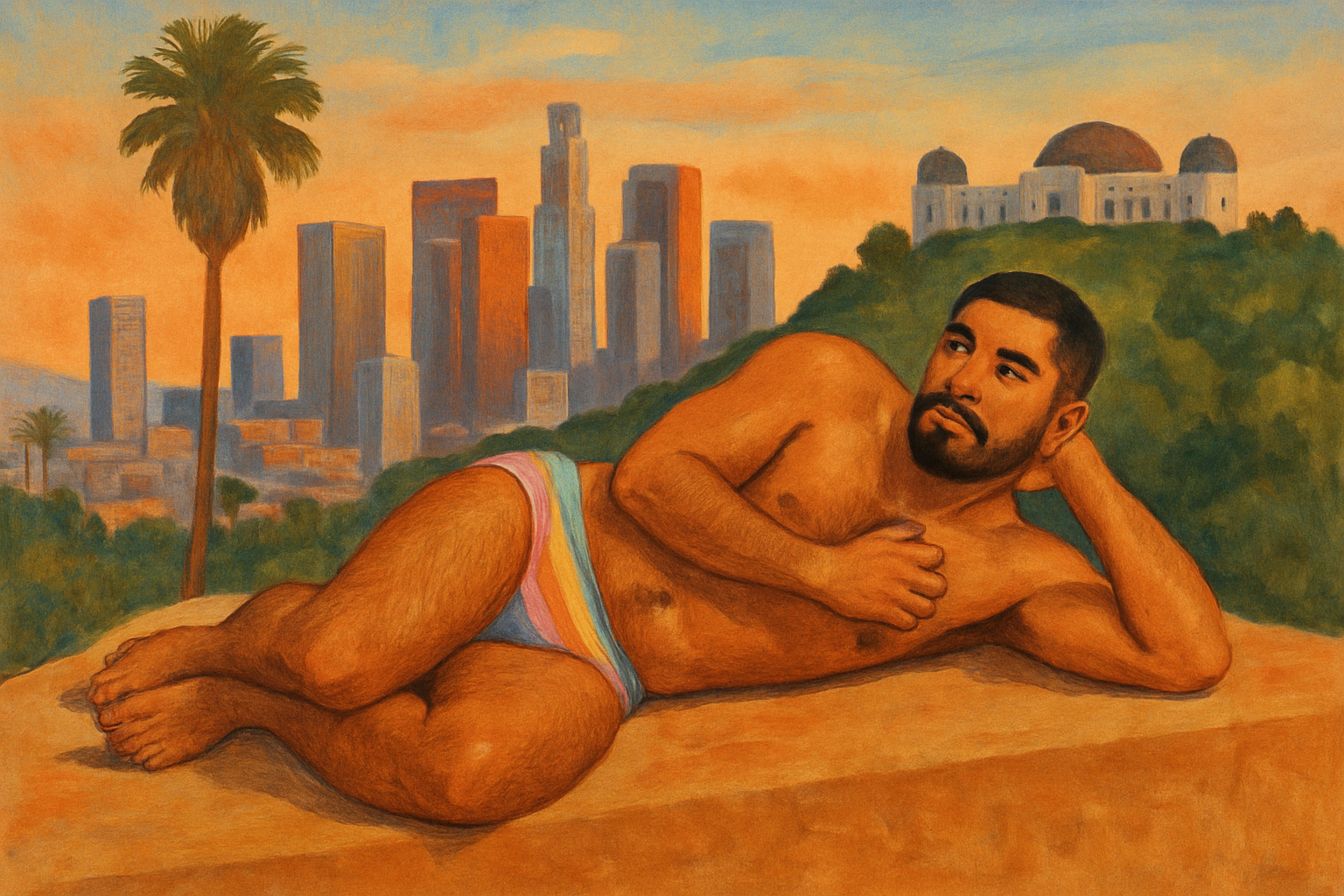
Rafa Esparza’s artistic practice is rooted in Los Angeles. Born in Pasadena in 1981 and raised in the region, Esparza continues to live and work in the city, bringing local histories and family knowledge into a multidisciplinary body of performance, video and installation work.
Esparza is the son of Mexican immigrants from Durango, Mexico. In 2014, he learned to make adobe bricks by hand from his father, adding a material and practical skill from his family life to his artistic vocabulary. That connection between inherited knowledge and artistic practice has remained an important part of how his work engages with place.
His education also connected him with influential currents in Los Angeles art. While attending East Los Angeles College, Esparza encountered the work of Asco, the East Los Angeles artist collective known for its experimental interventions. He later studied at UCLA, where he was influenced by the work of performance artist Ron Athey.
Esparza’s performances have often placed the body and the surrounding environment in direct relationship. In 2013, he presented “chino, indio, negro” with Sebastian Hernandez as part of Perform Chinatown. The performance took place near the site associated with the Chinese Massacre of 1871, linking contemporary live art with a specific and difficult history of Los Angeles. That same year, Esparza performed “El Hoyo” with his brother, Beto Esparza, and artist Nick Duran.
His collaborations have also extended into video. Esparza appeared in “O,” a video by Dorian Wood, adding another dimension to a practice that moves between solo performance, collective work and recorded media.
For the 2016 exhibition “Made in L.A. 2016: a, the, though, only,” Esparza buried a series of objects, including corn cobs, a mailbox pierced by a bullet, a recliner with a cactus growing from its seat and two black folding chairs. The objects’ placement transformed familiar items into part of an installation shaped by concealment, land and material history.
Esparza later presented the solo exhibition “Staring at the Sun” at MASS MoCA in North Adams, Massachusetts. Even as his work has traveled beyond Southern California, his biography and artistic development remain closely tied to Los Angeles: its neighborhoods, its layered histories, its performance traditions and the family practices that helped shape his understanding of materials and making.
Source and reuse information This backgrounder adapts factual material from “Rafa Esparza” on Wikipedia: https://en.wikipedia.org/wiki/Rafa_Esparza The adapted text is released under the Creative Commons Attribution-ShareAlike 4.0 International license (CC BY-SA 4.0): https://creativecommons.org/licenses/by-sa/4.0/. This story has not been independently reviewed or fact-checked.
Further links listed by the Wikipedia page (not independently checked): - https://www.nytimes.com/2016/11/18/arts/design/here-comes-the-whitney-biennial-reflecting-the-tumult-of-the-times.html - https://massmoca.org/event/rafa-esparza/ - https://www.theicala.org/en/exhibitions/18-rafa-esparza-de-la-calle - https://brooklynrail.org/2016/07/criticspage/things-left-behind-black-screen-169 - https://www.latimes.com/entertainment/arts/miranda/la-et-cam-rafa-esparza-uses-5000-adobe-bricks-to-construct-a-building-inside-a-building-at-lace-in-hollywood-20150722-column.html#page=1 - https://viaf.org/viaf/5466149198300274940006 Image rights Original illustrative artwork created from story keywords. It is not a documentary photograph.