LGBTQ+ · Los Angeles
W. Dorr Legg Helped Build Los Angeles’s Early Gay Rights Movement
Landscape architect W. Dorr Legg moved to Los Angeles in 1949 and became a central figure in the city’s early homophile movement, helping create support for interracial gay couples and publish ONE magazine.
By KLGBT News Desk ·
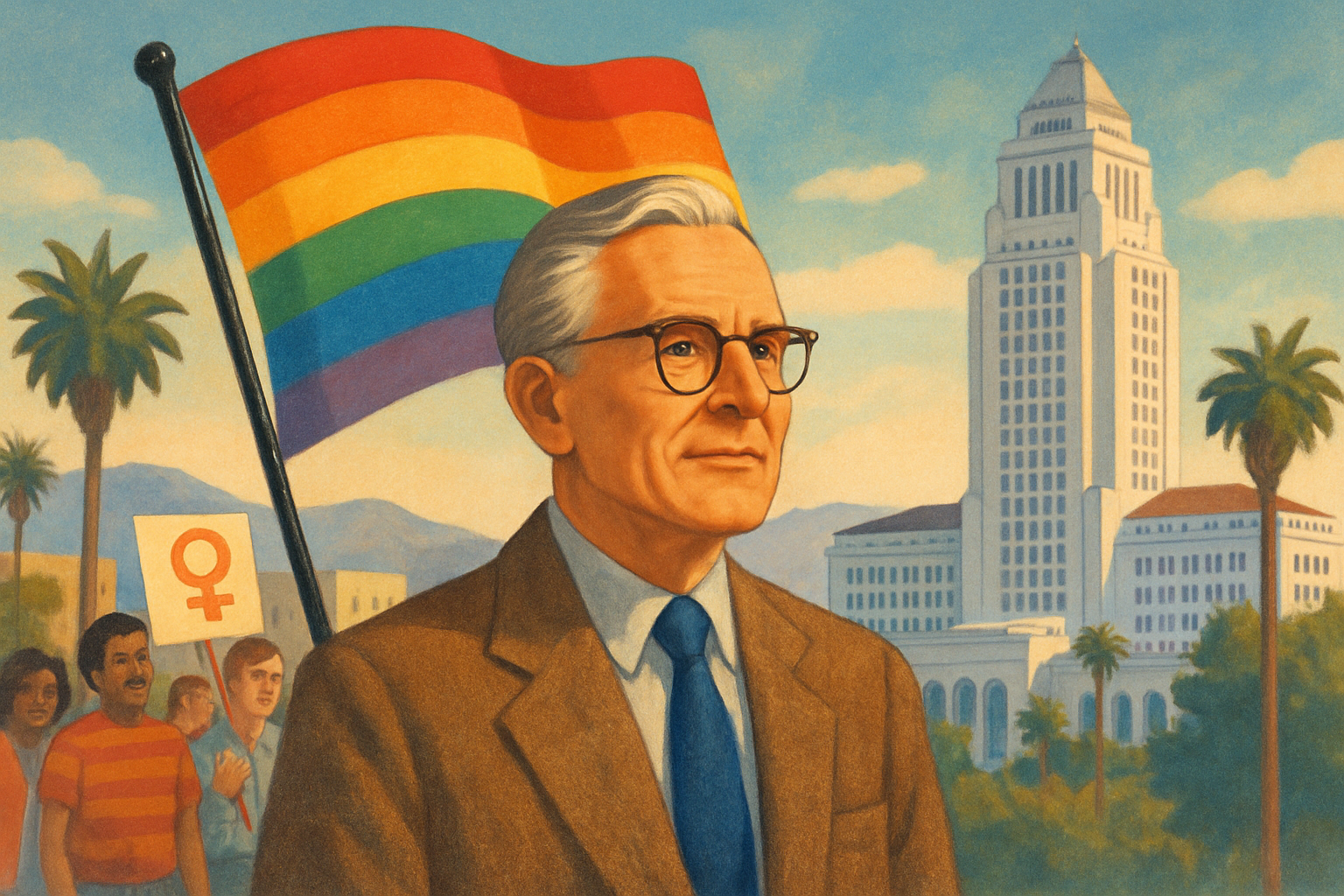
Before Los Angeles became known for its large and visible LGBTQ+ communities, W. Dorr Legg was helping create some of the structures that made organized gay rights advocacy possible.
Legg, born William Dorr Lambert Legg in Ann Arbor, Michigan, in 1904, trained as a landscape architect at the University of Michigan. He began teaching landscape architecture at Oregon State Agricultural College, now Oregon State University, in 1935. During the 1940s, he returned to Michigan to care for his father and assist with the family business.
In 1949, Legg moved to Los Angeles with his partner, Merton Bird. The following year, the two founded Knights of the Clock, a support organization for interracial gay couples. At a time when both same-sex relationships and interracial partnerships faced discrimination and social isolation, the group provided a way for couples to find community and support.
Legg and Bird also became involved with the Mattachine Society, one of the early national organizations advocating for gay people. They soon aligned with members who left the society and went on to establish ONE, Inc. That organization published ONE magazine, identified in the research as the first homophile magazine. “Homophile” was the movement’s earlier term for gay rights advocacy.
As publisher of ONE’s monthly magazine, Legg took part in a legal fight involving the United States Postal Service. He sued the agency to defend the publication’s right to be distributed, placing questions about censorship and access to gay-focused information before the courts. The extract does not provide the outcome or additional details of that case, but the dispute illustrates the practical barriers early LGBTQ+ publishers faced.
Legg’s work connected several parts of the emerging movement: mutual aid for couples, organized activism, and the circulation of information through an independent publication. His background in landscape architecture also reflects the varied paths taken by people who became leaders in early gay rights organizing; he was not initially a professional activist, but a trained designer and educator who helped shape a new community institution after settling in Los Angeles.
Legg died on July 26, 1994, at age 89. His Los Angeles years remain significant because they place him among the people who helped turn private experiences of discrimination and isolation into organized community work. Through Knights of the Clock and ONE, Inc., Legg contributed to an early local and national movement whose language and strategies would continue to develop over subsequent decades.
Source and reuse information This backgrounder adapts factual material from “W. Dorr Legg” on Wikipedia: https://en.wikipedia.org/wiki/W._Dorr_Legg The adapted text is released under the Creative Commons Attribution-ShareAlike 4.0 International license (CC BY-SA 4.0): https://creativecommons.org/licenses/by-sa/4.0/. This story has not been independently reviewed or fact-checked.
Further links listed by the Wikipedia page (not independently checked): - https://viaf.org/viaf/36157125 - https://www.amazon.com/Homosexuals-Today-Handbook-Organizations-Publications/dp/B0019CSLMW/ref=sr_1_cc_3?s=aps&ie=UTF8&qid=1459400643&sr=1-3-catcorr&keywords=homosexuals+today+1956 - https://www.amazon.com/Homophile-Studies-In-Theory-Practice/dp/1879194171?ie=UTF8&keywords=homophile%20studies&qid=1459400507&ref_=sr_1_1&sr=8-1 - https://www.amazon.com/gp/product/1879194171 - https://web.archive.org/web/20060221073022/http://williamapercy.com/pub-Stonewall.htm - https://www.jstor.org/action/doBasicSearch?Query=%22W.+Dorr+Legg%22&acc=on&wc=on Image rights Original illustrative artwork created from story keywords. It is illustrative, not a documentary photograph.