LGBTQ+ · Miami
Before Modern LGBTQ Rights, Florida’s Laws Cast a Long Shadow Over Miami
Florida’s early criminal laws did not name homosexuality directly, but they created a legal climate that shaped LGBTQ life in Miami well into the 20th century.
By KLGBT News Desk ·
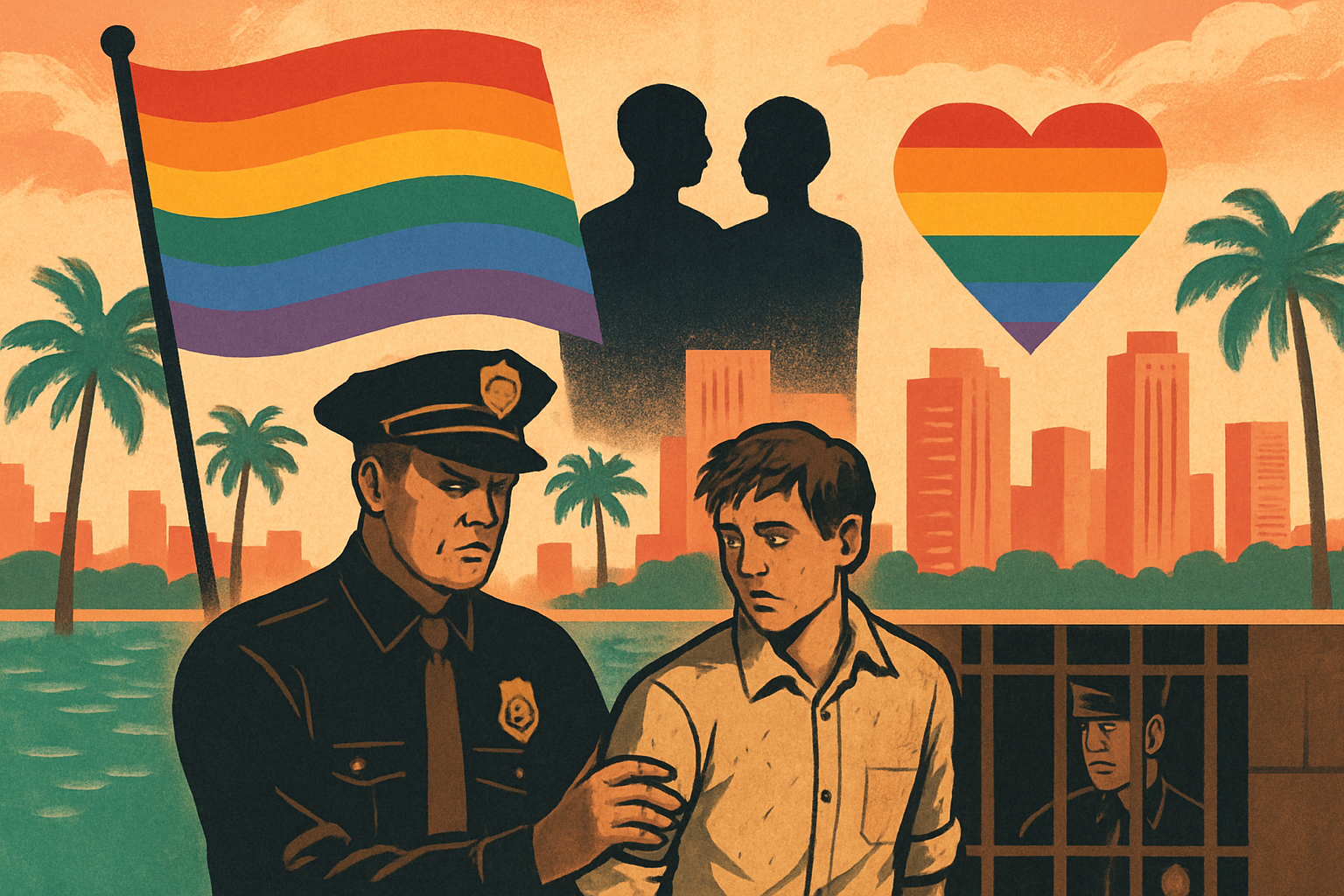
The history of LGBTQ life in Miami cannot be separated from Florida’s broader legal history. Long before the state had modern protections or public conversations about sexual orientation, Florida law treated certain forms of intimacy and sexuality as matters for criminal punishment.
When Florida became a U.S. territory in 1821, its Territorial Legislature adopted laws addressing fornication, adultery, bigamy and incest. It also prohibited broadly defined public behavior considered indecent or harmful to public morals. Those measures did not specifically identify homosexuality, but they established a framework in which authorities could police sexuality through morality laws.
Florida enacted its first law specifically addressing sodomy in 1845, the year the state entered the Union. The law classified sodomy as a felony and authorized a state-prison sentence of up to 20 years. Its language applied to acts involving either a person or an animal, reflecting the period’s legal approach of grouping conduct under the category of crimes “against nature.”
In 1917, lawmakers added another offense involving what the statute described as an “unnatural and lascivious act” with another person. That provision was classified as a second-degree misdemeanor, carrying a possible fine of as much as $500 or up to six months in jail. The law did not expressly mention homosexuality.
That distinction matters. Florida’s statutes often relied on broad concepts such as indecency, unnatural conduct and public morality rather than naming gay people or same-sex relationships directly. Even without explicit references to homosexuality, those laws gave the state tools to regulate conduct associated with sexual and gender nonconformity.
In Miami, the social climate around homosexuality followed patterns seen in other American cities. The city had a lively gay nightlife during the 1930s, indicating that LGBTQ social life existed openly enough to become part of the urban entertainment scene. By the 1950s, however, the atmosphere had changed. The contrast between nightlife in the earlier decade and the more restrictive climate that followed illustrates how visible LGBTQ communities could coexist with legal vulnerability and shifting public attitudes.
This early history offers important context for understanding later LGBTQ organizing and rights struggles in Miami and throughout Florida. The absence of the word “homosexuality” from a law did not mean LGBTQ people were outside its reach. Broad criminal statutes and public-morality rules could still shape where people gathered, how visible they felt and how safely they could form communities.
For Miami, the story begins with both realities: a city where LGBTQ nightlife had a presence by the 1930s, and a state legal system whose roots included severe penalties for sexual conduct and broad authority to punish behavior deemed indecent. That tension would remain central to Florida’s LGBTQ history for decades.
Source and reuse information This backgrounder adapts factual material from “LGBTQ history in Florida” on Wikipedia: https://en.wikipedia.org/wiki/LGBTQ_history_in_Florida The adapted text is released under the Creative Commons Attribution-ShareAlike 4.0 International license (CC BY-SA 4.0): https://creativecommons.org/licenses/by-sa/4.0/. This story has not been independently reviewed or fact-checked.
Further links listed by the Wikipedia page (not independently checked): - https://books.google.com/books?id=RTlFAAAAYAAJ&pg=PA120 - https://books.google.com/books?id=kiKv4RN7JnUC&pg=PA14 - https://www.nytimes.com/2003/06/26/politics/26WIRE-SODO.html - https://web.archive.org/web/20100621050533/https://justice.law.stetson.edu/lawrev/abstracts/PDF/33-1Turbe.pdf - https://queerintheworld.com/gay-fort-lauderdale-florida-travel-guide/ - https://www.pnj.com/story/news/history/2016/05/27/researcher-highlights-pensacolas-lgbt-memorial-day-history/84903728/ Image rights Original illustrative artwork created from story keywords. It is illustrative, not a documentary photograph.