LGBTQ+ · Miami
Gianni Versace’s Miami Beach Legacy Connects Fashion, Music and Queer History
The Italian designer’s final home in Miami Beach became the setting for a tragedy that remains part of the city’s cultural and LGBTQ history.
By KLGBT News Desk ·
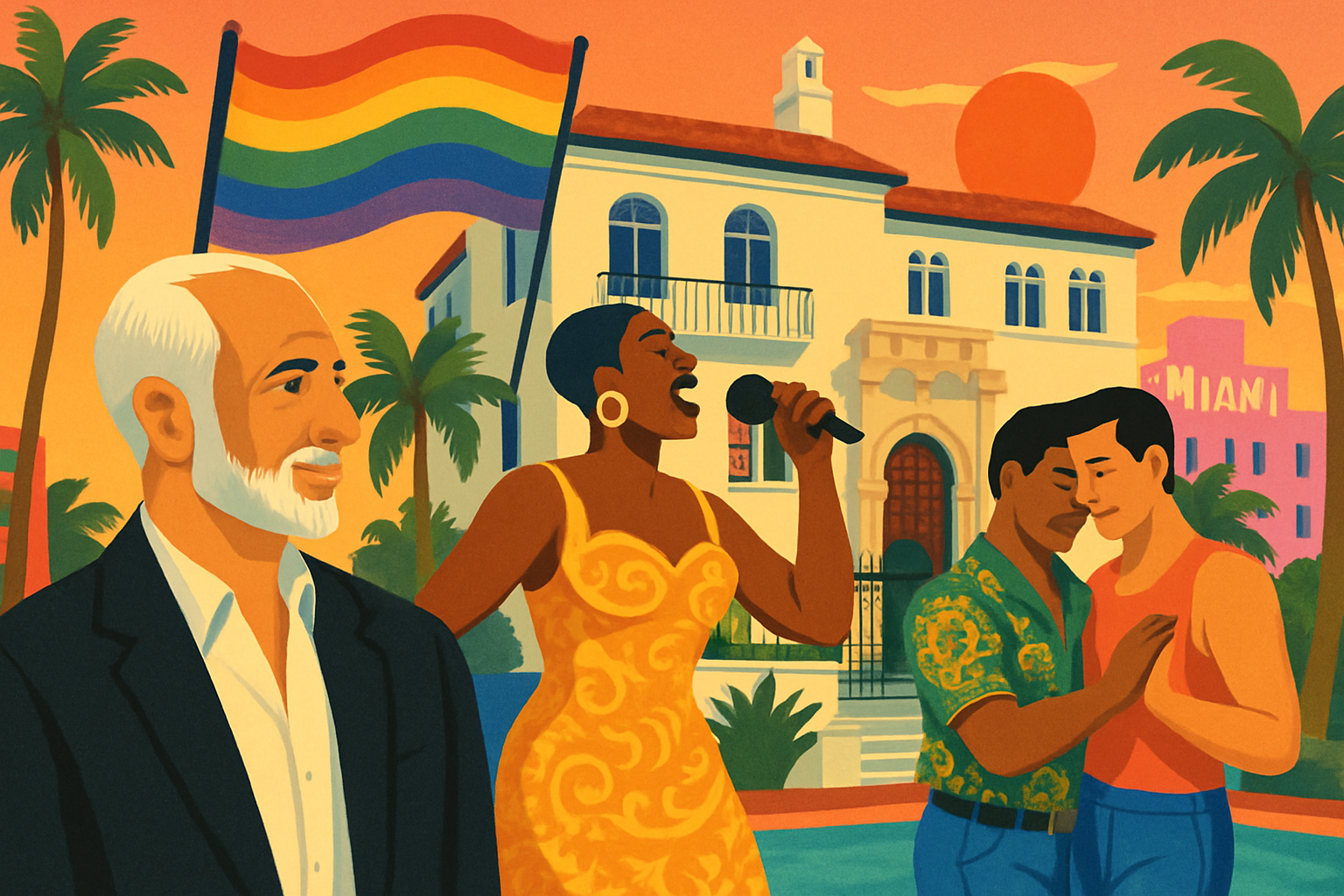
Gianni Versace’s name is permanently connected to Miami Beach. The Italian designer was killed on July 15, 1997, outside Casa Casuarina, the mansion he called home. His death brought international attention to a residence that had already reflected the glamour, creative energy and celebrity culture associated with Versace’s life and work.
Born Giovanni Maria Versace on December 2, 1946, in Reggio Calabria, Italy, Versace grew up in a family shaped by clothing. His mother, Francesca, was a dressmaker, and his early surroundings influenced the career that would eventually make him one of the most recognizable designers in the world. He founded the Versace fashion house, which expanded beyond clothing into accessories, fragrances, makeup and home furnishings.
Versace’s influence also reached beyond the runway. He created costumes for theater and film, and he helped strengthen the relationship between high fashion and popular music. His circle included performers and public figures such as Elton John, Madonna, Whitney Houston, Tupac Shakur and Naomi Campbell. That connection made his work part of a broader cultural conversation, in which fashion, performance and celebrity increasingly overlapped.
His personal life was also visible within that international world. Versace and his partner, Antonio D’Amico, were regular figures on the global party circuit. For LGBTQ audiences, that public partnership is part of Versace’s enduring significance: his legacy is not limited to the clothes he designed, but also includes the place he occupied within a highly visible creative and social community.
Miami Beach became the final setting in Versace’s story. On that July day, he was murdered outside Casa Casuarina by Andrew Cunanan, a spree killer. The event ended the life of a designer whose career had crossed national borders and artistic disciplines, but it did not erase the cultural imprint he had made.
Versace’s story remains especially resonant in Miami because the city was not simply a location in his biography. Casa Casuarina represented his presence in a place known for its strong links to fashion, nightlife, architecture and celebrity. His connection to the city continues to sit at the intersection of those worlds.
For Miami’s LGBTQ community, remembering Versace means holding several parts of that history together: an Italian immigrant family’s fashion legacy, a designer’s embrace of music and performance, a same-sex partnership lived within public view, and a life cut short at a Miami Beach home. His influence remains a reminder that queer cultural history is often preserved not only in institutions, but also in the people whose work and visibility reshape how a city sees itself.
Source and reuse information This backgrounder adapts factual material from “Gianni Versace” on Wikipedia: https://en.wikipedia.org/wiki/Gianni_Versace The adapted text is released under the Creative Commons Attribution-ShareAlike 4.0 International license (CC BY-SA 4.0): https://creativecommons.org/licenses/by-sa/4.0/. This story has not been independently reviewed or fact-checked.
Further links listed by the Wikipedia page (not independently checked): - https://viaf.org/viaf/5133380 - https://rkd.nl/en/explore/artists/115171 - https://books.google.com/books?id=w1vpiOUrnZgC&pg=PT334 - https://www.idref.fr/050245090 - https://movies.nytimes.com/person/1258494/Gianni-Versace/filmography - https://id.ndl.go.jp/auth/ndlna/00715887 Image rights Original illustrative artwork created from story keywords. It is illustrative, not a documentary photograph.