LGBTQ+ · Miami
How Miami’s Save Our Children Campaign Helped Shape the National Fight Over LGBTQ+ Rights
The 1977 Miami campaign to repeal Dade County’s sexual-orientation nondiscrimination ordinance became a major early test for the LGBTQ+ rights movement—and a model for similar efforts elsewhere.
By KLGBT News Desk ·
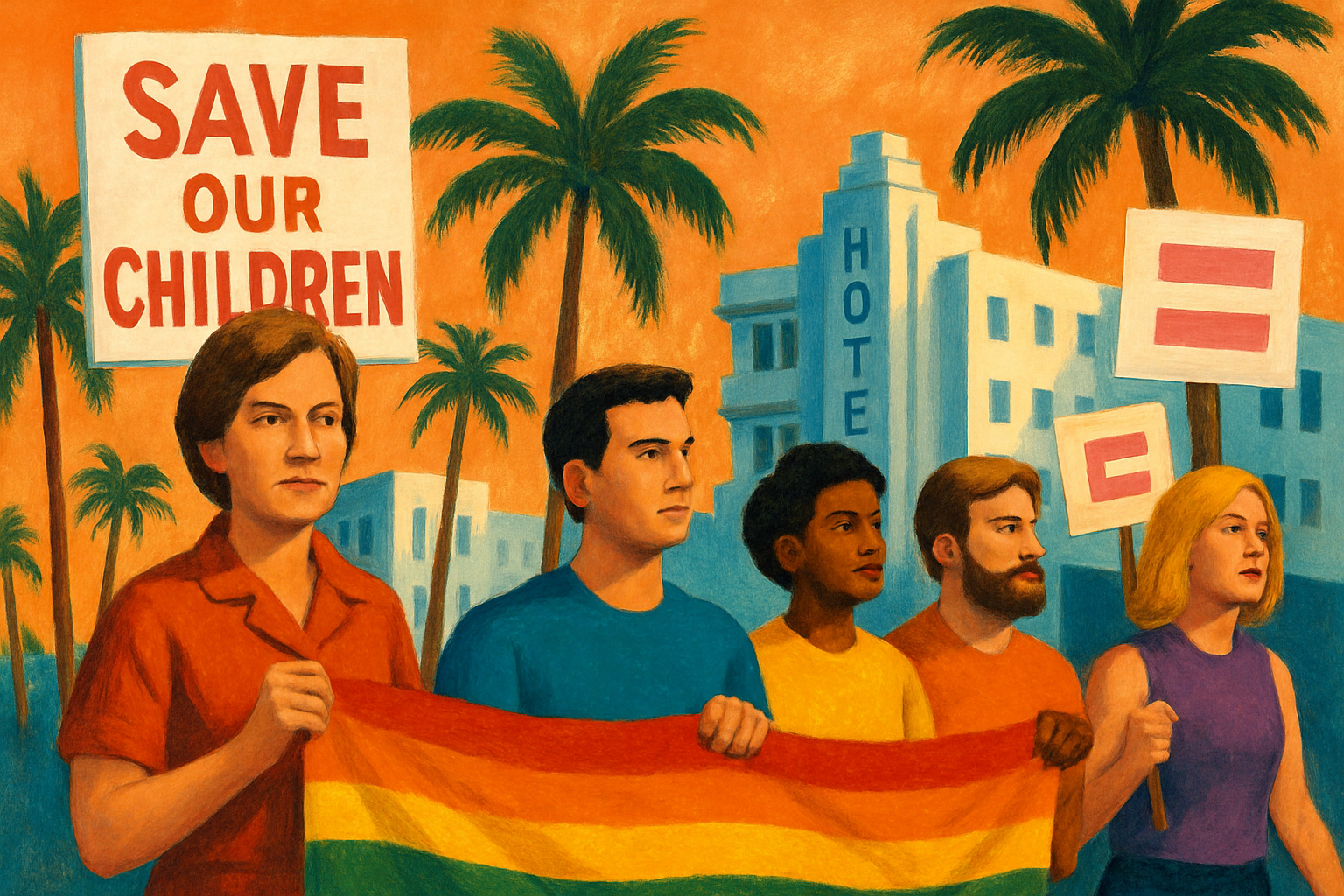
In 1977, Miami became the center of a major political fight over LGBTQ+ rights when a coalition called Save Our Children, Inc. organized to repeal a newly enacted Dade County ordinance.
The ordinance prohibited discrimination based on sexual orientation in housing, employment and public accommodations. Its opponents argued that the measure conflicted with their religious beliefs and their authority to teach biblical morality to their children. The campaign was publicly led by singer Anita Bryant, whose celebrity helped give the repeal effort a prominent national profile.
Save Our Children’s campaign confronted a local gay rights movement that, according to historical accounts, was less prepared for the scale and organization of the opposition. The contest quickly became a bitter struggle between LGBTQ+ activists defending the ordinance and Christian fundamentalists seeking to overturn it.
When the repeal went before voters, the election drew the largest turnout recorded for a special election in Dade County at that time. The ordinance was repealed by a 70 percent vote.
The Miami result had consequences well beyond the county. Save Our Children is described as the first organized opposition to the modern gay rights movement, which traces its beginnings to the 1969 Stonewall riots. The repeal demonstrated that a coordinated campaign against LGBTQ+ protections could succeed at the ballot box, and groups in other cities adopted related strategies.
Within the following year, voters in St. Paul, Minnesota; Wichita, Kansas; and Eugene, Oregon, also overturned local nondiscrimination ordinances. The campaigns shared many of the methods used in Miami, linking the Dade County vote to a broader national effort to roll back legal protections for gay people.
For Miami’s LGBTQ+ community, the episode remains a defining chapter in the city’s political history. It showed both the vulnerability of newly won protections and the reach that a local ballot fight could achieve. The campaign also helped establish a pattern that would recur in later debates: LGBTQ+ nondiscrimination rules were presented not only as questions of employment, housing or public access, but also as conflicts over religion, family and public morality.
The 1977 repeal did not end the national debate over LGBTQ+ rights. Instead, it helped move that debate from local policy discussions into a wider political arena, where similar ordinances faced organized challenges in cities across the United States.
Source and reuse information This backgrounder adapts factual material from “Save Our Children” on Wikipedia: https://en.wikipedia.org/wiki/Save_Our_Children The adapted text is released under the Creative Commons Attribution-ShareAlike 4.0 International license (CC BY-SA 4.0): https://creativecommons.org/licenses/by-sa/4.0/. This story has not been independently reviewed or fact-checked.
Further links listed by the Wikipedia page (not independently checked): - https://web.archive.org/web/20070609231912/http://stonewall-library.org/anita/panel1.html - https://www.miamiherald.com/news/local/community/gay-south-florida/article5449227.html - https://www.theguardian.com/us-news/2025/jan/09/anita-bryant-singer-anti-gay-rights-crusader-dies - https://www.miaminewtimes.com/news/miami-dade-passes-transgender-inclusive-human-rights-ordinance-6537523#:~:text=The%20historic%20vote%20came%20last%20night%20after%20four,Jean%20Monestime%20and%20Xavier%20Suarez%20voted%20in%20favor - https://www.nytimes.com/1977/07/16/archives/antihomosexual-group-barred-from-use-of-name.html - https://www.nytimes.com/1977/11/18/archives/around-the-nation-a-mistrial-is-declared-in-smut-magazine-case.html Image rights Original illustrative artwork created from story keywords. It is not a documentary photograph.