LGBTQ+ · Miami
Remembering F. Warren O’Reilly, the Gay Activist Who Shaped Miami’s Music Scene
F. Warren O’Reilly connected LGBTQ+ advocacy, music journalism, and cultural institution-building in Miami, leaving records of his work at the University of Miami.
By KLGBT News Desk ·
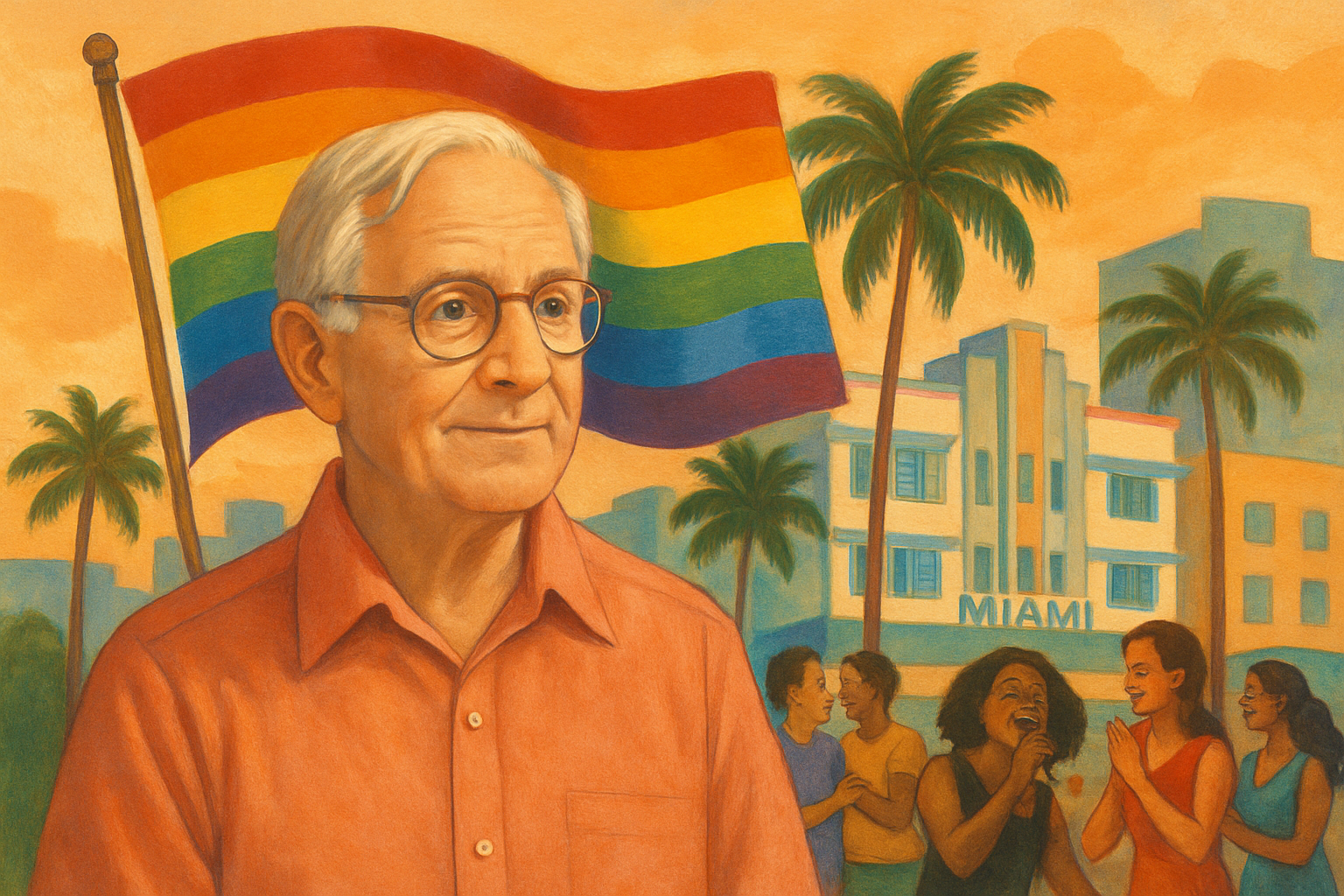
F. Warren O’Reilly’s legacy in Miami sits at the intersection of LGBTQ+ history and the city’s musical life. A gay activist, music editor, educator, and arts organizer, O’Reilly helped create institutions and events that brought ambitious classical music programming to South Florida.
Born in 1921, O’Reilly served during World War II and later attended New York City College. During the 1970s, he worked as the music editor of The Miami News. In that role, he organized the Charles Ives Festival in Miami in 1973, assembling a festival committee that included major figures from 20th-century music: Leonard Bernstein, Leopold Stokowski, Lou Harrison, and John Cage.
The festival became one part of a broader cultural career. O’Reilly also served as an adjunct professor at the University of Miami School of Music. His work with the Chopin Foundation was another significant part of his professional life: he was president and executive director of The Chopin Foundation of the United States, as well as a founder of the organization.
O’Reilly’s identity as a gay man is central to how his life is remembered. His gravestone at Congressional Cemetery in Washington, D.C., identifies him as a gay World War II veteran. The inscription also reflects his critical view of the nation’s promise of equality, ending with a reference to “Liberty and Justice for SOME.”
That wording gives his memorial a distinctly political and personal dimension. It links military service, sexual identity, and an unresolved argument about who has been included in American ideals. For a city with a deep LGBTQ+ history, O’Reilly’s story offers a reminder that queer Miami history was also shaped by people working in journalism, universities, and the arts—not only by formal political organizations or nightlife venues.
The University of Miami’s Special Collections holds the F. Warren O’Reilly papers, covering material from 1922 through 2001. The archive provides a local record of a life that moved among music criticism, education, cultural leadership, and gay activism.
O’Reilly died in 2001. His work remains part of Miami’s institutional and cultural history, while his chosen epitaph preserves a direct statement about the limits of equality during his lifetime. Together, the archive and the gravestone help document a figure whose contributions reached well beyond a single festival or organization.
Source and reuse information This backgrounder adapts factual material from “Frank Warren O'Reilly” on Wikipedia: https://en.wikipedia.org/wiki/Frank_Warren_O%27Reilly The adapted text is released under the Creative Commons Attribution-ShareAlike 4.0 International license (CC BY-SA 4.0): https://creativecommons.org/licenses/by-sa/4.0/. This story has not been independently reviewed or fact-checked.
Further links listed by the Wikipedia page (not independently checked): - https://www.newspapers.com/clip/16849511/the_miami_news/ - https://www.newspapers.com/clip/16849545/the_miami_news/ - https://www.newspapers.com/clip/16849617/the_miami_news/ - https://www.newspapers.com/clip/16849649/the_miami_news/ - https://www.nytimes.com/1977/09/18/archives/notes-lending-wagner-a-hand-help-for-wagner.html - https://books.google.com/books?id=47s_0MW_bkoC&pg=PA164 Image rights Original illustrative artwork created from story keywords. It is not a documentary photograph.