LGBTQ+ · New York City
Bialogue’s New York Roots and the Fight Against Bisexual Erasure
Founded in New York City in 2005, Bialogue brought together two earlier activist groups to challenge biphobia, correct misconceptions about bisexuality and advocate for bisexual, fluid, pansexual and queer-identified communities.
By KLGBT News Desk ·
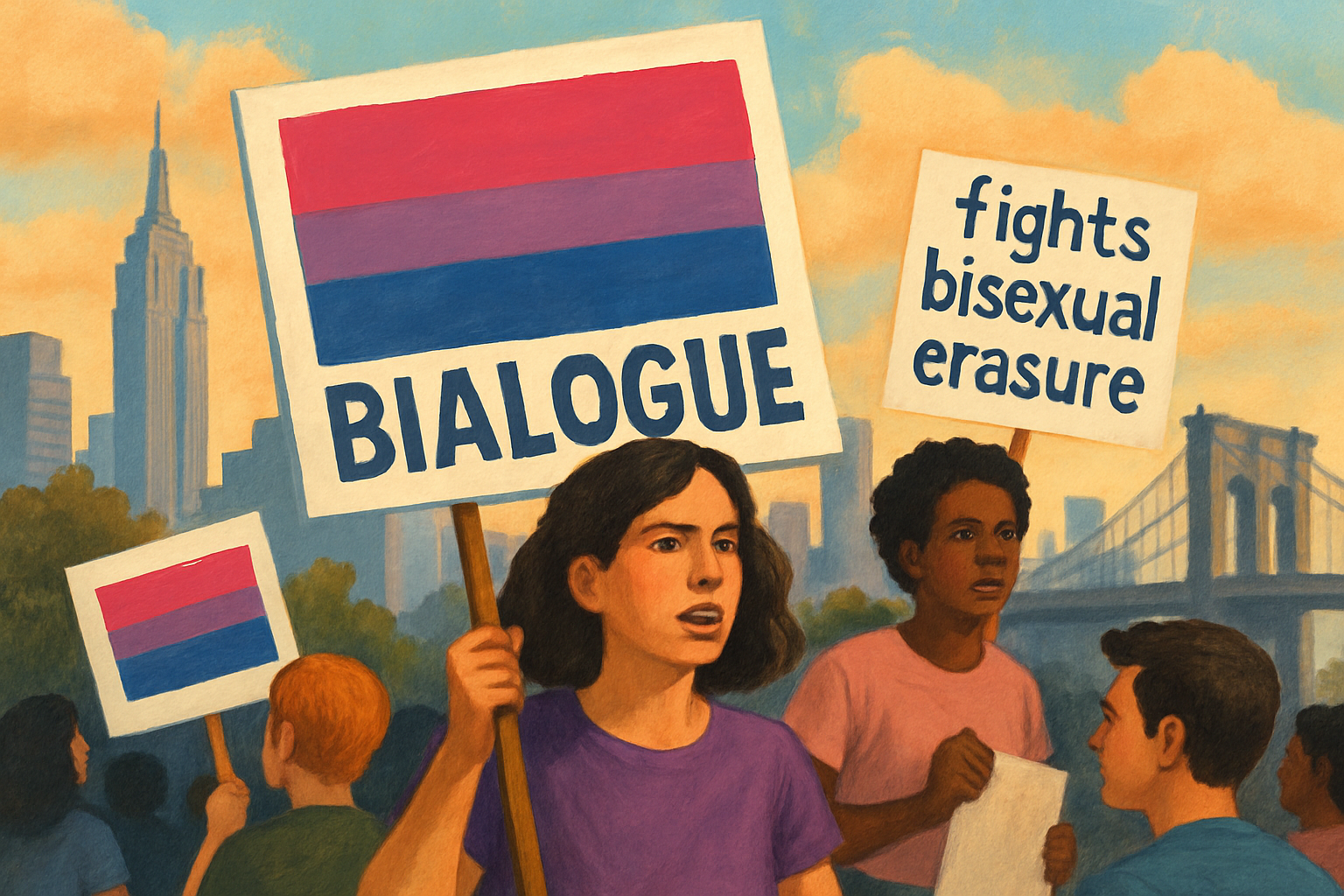
New York City has been home to organized bisexual activism for decades, including the work that led to Bialogue. Founded in 2005, the group emerged from the merger of two New York-based organizations: the Bisexual Political Action Committee, known as BiPAC, and the Coalition for Unity and Inclusion.
Bialogue takes its name from a blend of “bisexual” and “dialogue,” reflecting its focus on public education and community advocacy. Its work addresses issues affecting bisexual, fluid, pansexual and queer-identified people, as well as allies. The organization’s stated goals include challenging myths about bisexuality, confronting biphobia and bisexual erasure, and sharing information about the realities of bisexual lives and identities.
The group’s origins reach back to 1989, when BiPAC was established as an explicitly activist political organization. BiPAC focused on opposing biphobia and bisexual erasure, while also working on concerns specific to New York City’s bisexual community. Its organizing took place alongside broader LGBTQ and progressive movements in the city.
Among the groups with which BiPAC worked were ACT UP, Queer Nation, the Irish Lesbian and Gay Organization, Children of the Rainbow, Por Los Niños and the Coalition. These connections placed bisexual organizing within a larger network of New York activism, linking identity-specific advocacy with campaigns involving LGBTQ rights and other progressive causes.
The creation of Bialogue brought that earlier political work together with a broader educational and community-oriented mission. Rather than treating bisexuality as a temporary phase, a divided identity or an issue that can be folded entirely into other LGBTQ categories, the organization’s stated purpose is to make bisexual experiences visible and to counter the assumptions that contribute to exclusion.
That focus addresses a recurring challenge in LGBTQ advocacy: bisexual people can face misunderstanding or marginalization both outside and within LGBTQ communities. Bialogue’s agenda identifies erasure itself as a problem, emphasizing the need for accurate public information and direct advocacy.
The organization describes its approach as taking action rather than merely expressing offense. In New York City, that philosophy connects a long-running history of bisexual political organizing with efforts to educate the public, oppose discrimination and build recognition for a wide range of identities. Bialogue’s history also illustrates how local activist groups can develop over time, joining forces while preserving a focus on issues that may otherwise receive limited attention in broader LGBTQ conversations.
Source and reuse information This backgrounder adapts factual material from “Bialogue” on Wikipedia: https://en.wikipedia.org/wiki/Bialogue The adapted text is released under the Creative Commons Attribution-ShareAlike 4.0 International license (CC BY-SA 4.0): https://creativecommons.org/licenses/by-sa/4.0/. This story has not been independently reviewed or fact-checked.
Further links listed by the Wikipedia page (not independently checked): - https://web.archive.org/web/20100728163820/http://lib.sdstate.edu/GuideoftheMonth/glbtjune.htm - https://web.archive.org/web/20060419004109/http://www.fair.org/index.php?page=2573 - https://web.archive.org/web/20100108022902/http://bialogue.livejournal.com/ - https://web.archive.org/web/20110928211821/http://www.americablog.com/2005/07/bisexuality-study-nyt-gives-prominence.html - https://web.archive.org/web/20110829005046/http://www.binetusa.org/Pages/network.html Image rights Original illustrative artwork created from story keywords. It is illustrative, not a documentary photograph.