LGBTQ+ · New York City
How New York City’s Veterans Benevolent Association Challenged Unequal Military Discharges
Founded in New York City in 1945, the Veterans Benevolent Association created a social network for gay veterans while confronting the discrimination attached to blue military discharges.
By KLGBT News Desk ·
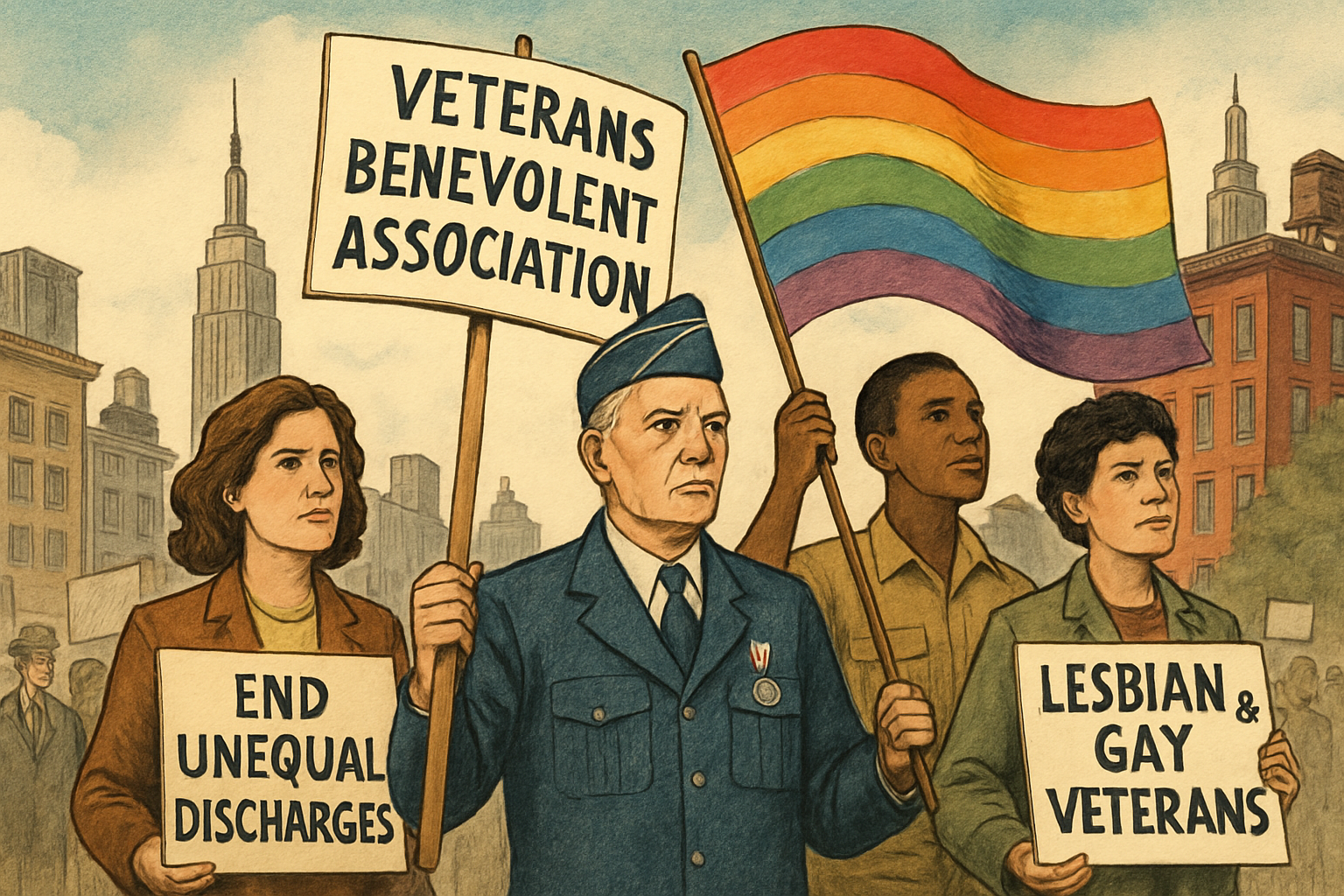
In the years after World War II, four honorably discharged gay veterans founded the Veterans Benevolent Association in New York City. Established in 1945, the group offered LGBT veterans a place to meet and socialize at a time when their military records could carry serious consequences after service.
The VBA was more than a social organization. Its work grew out of anger over the treatment of gay veterans who received “blue discharges,” a separation from the military that was considered less than honorable but not dishonorable. The discharge was named for the color of the paper on which it was printed.
For veterans who received one, the document could affect access to benefits. A Veterans Administration directive excluded blue-discharge holders from the G.I. Bill, even though the law included language prohibiting that kind of denial. According to the historical record, the exclusion of LGBT former service members continued for years after the military stopped using blue discharges.
The policy also affected African American service members at disproportionate rates. In response, the VBA joined with the NAACP in a campaign against what the groups viewed as the arbitrary use of blue discharges against both gay veterans and Black veterans. Their coalition connected discrimination based on sexual orientation with broader questions about race, military justice and access to federal benefits.
The organization formally incorporated in New York State in 1947, placing it among the earliest incorporated groups representing LGBT veterans. Its emergence in New York City illustrates how the city served as a gathering point for people seeking community while also building organized responses to government policy.
The VBA’s history sits at the intersection of LGBTQ+ life, veterans’ rights and civil-rights advocacy. Its members were navigating two realities at once: military service that had ended, and a government classification that could limit the benefits promised to veterans. By creating an association and joining a cross-racial campaign, they turned a private grievance into a public demand for fair treatment.
For New Yorkers today, the organization’s story is a reminder that LGBTQ+ history is not limited to cultural institutions or social life. It also includes the groups that challenged administrative rules and fought over who would receive the recognition and resources associated with military service.
Source and reuse information This backgrounder adapts factual material from “Veterans Benevolent Association” on Wikipedia: https://en.wikipedia.org/wiki/Veterans_Benevolent_Association The adapted text is released under the Creative Commons Attribution-ShareAlike 4.0 International license (CC BY-SA 4.0): https://creativecommons.org/licenses/by-sa/4.0/. This story has not been independently reviewed or fact-checked. Image rights Original illustrative artwork created from story keywords. It is not a documentary photograph.