LGBTQ+ · New York City
Queens Liberation Front Put Drag Queens at the Center of New York’s Liberation Movement
Founded in 1969, the Queens Liberation Front organized in New York City for drag queens’ rights and helped make trans people’s visibility part of the city’s LGBTQ+ movement.
By KLGBT News Desk ·
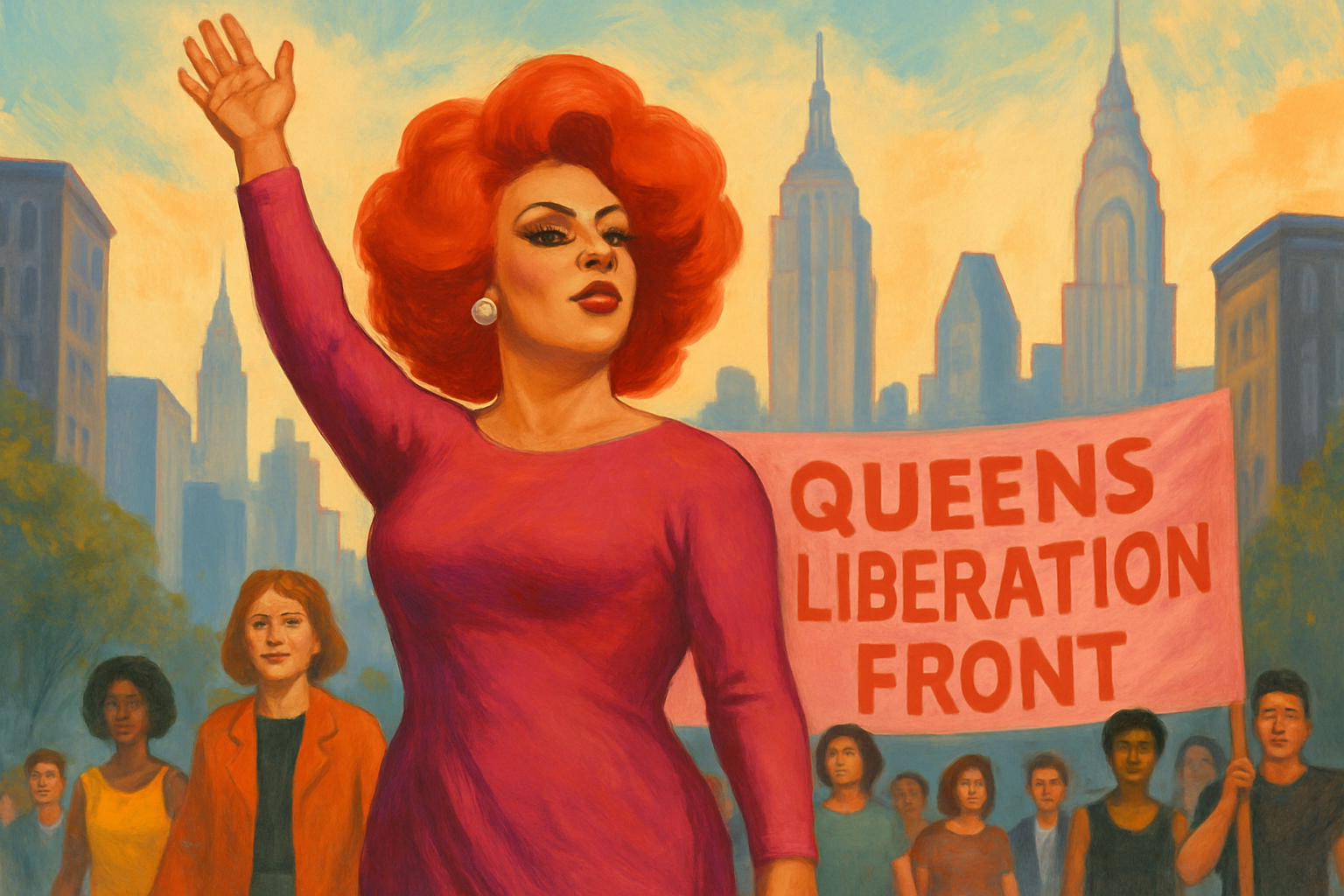
Before “LGBTQ+” became the broad umbrella commonly used today, New York City’s liberation movement was shaped by groups organizing around more specific identities and experiences. The Queens Liberation Front, founded in 1969, was one of the organizations that made drag queens and transvestites a visible focus of LGBTQ+ activism.
The group was established by Lee Brewster, who announced plans for its creation at a ball in February 1969. Halloween—an important occasion in the drag community—was designated as the organization’s formal founding date later that year. QLF remained active through the 1970s, combining public advocacy with community media and coalition work.
Its formation reflected tensions within the emerging gay liberation movement. At the first Christopher Street Liberation Day march, held in June 1970, drag queens were reportedly relegated toward the back of the procession. Members of the Street Transvestite Action Revolutionaries, commonly known as STAR, moved to the front in protest and marched there. The episode illustrated a conflict that would recur in LGBTQ+ organizing: people who faced some of the sharpest discrimination were not always given equal standing within movements seeking broader acceptance.
QLF’s work included advocacy for the rights of transvestites and participation in wider LGBTQ+ events. The organization collaborated with groups including the Gay Activists Alliance and STAR, linking its work to other New York efforts for queer political visibility and rights. Those relationships also placed drag-focused organizing within the city’s larger network of activist groups.
In 1971, QLF began publishing Drag Queens: A Magazine About the Transvestite. The publication gave the organization another way to communicate with its community and to advance its advocacy. Its existence also underscores how activism in the period extended beyond marches and demonstrations: organizers created their own spaces for information, representation and debate.
The Queens Liberation Front’s history is part of New York City’s LGBTQ+ story because it shows how liberation politics were contested from within. By organizing specifically around drag queens and transvestites, QLF challenged the idea that a movement could speak for everyone while pushing some of its most visible members aside. Its alliances with other groups and its publishing work helped preserve a place for gender-nonconforming people in the city’s political history.
Source and reuse information This backgrounder adapts factual material from “Queens Liberation Front” on Wikipedia: https://en.wikipedia.org/wiki/Queens_Liberation_Front The adapted text is released under the Creative Commons Attribution-ShareAlike 4.0 International license (CC BY-SA 4.0): https://creativecommons.org/licenses/by-sa/4.0/. This story has not been independently reviewed or fact-checked.
Further links listed by the Wikipedia page (not independently checked): - https://vimeo.com/57691610 - https://www.digitaltransgenderarchive.net/files/v979v309v - https://books.google.com/books?id=jA8l8EYcnHsC&pg=PA113 - https://books.google.com/books?id=kEfZ1knAguMC&pg=PT191 - https://books.google.com/books?id=_LTbAgAAQBAJ&pg=PA122 - https://books.google.com/books?id=ML2SAgAAQBAJ&pg=PA142 Image rights Original illustrative artwork created from story keywords. It is not a documentary photograph.