Beyond the Bay · New York City
Remembering the V Train, New York’s Short-Lived Sixth Avenue Local
The V train connected Forest Hills and Manhattan’s Lower East Side on weekdays from 2001 until a 2010 budget-driven service reduction ended the route.
By KLGBT News Desk ·
For less than nine years, New York City subway riders could take the orange V train between Queens and Manhattan. The weekday service ran from 71st Avenue in Forest Hills to Second Avenue, near the boundary between the East Village and the Lower East Side.
The V entered service on December 17, 2001. Its creation followed the opening of a connection between the IND 63rd Street Line and the IND Queens Boulevard Line. That new link changed the F train’s path: the F moved onto the 63rd Street connection instead of continuing through the IND 53rd Street Line. The V was introduced to provide another route along Sixth Avenue while serving the Queens Boulevard corridor.
The service operated through the heart of Manhattan on the IND Sixth Avenue Line, which gave it an orange route bullet. It ran only on weekdays, beginning at roughly 6:30 a.m. and ending around midnight. At its eastern end, Second Avenue placed the train close to the East Village and Lower East Side rather than at a terminal farther south in Manhattan.
For most of its existence, the V kept the same basic route and schedule. The available service history notes one brief change in early 2005, but otherwise describes an eight-and-a-half-year run with a consistent pattern. That stability made the V a distinct part of the subway map during the 2000s, even though it did not operate on weekends.
The route ended on June 25, 2010, during a series of reductions intended to address a budget shortfall. Rather than leaving the V’s service pattern entirely absent, the Metropolitan Transportation Authority combined most of it with the M train. The M was rerouted through the Chrystie Street Connection, replacing service that had previously run through Lower Manhattan and parts of South Brooklyn. The Second Avenue portion was the exception to that combination.
The V’s brief history reflects how changes to one subway connection can reshape several routes at once. A new link for the F created a separate weekday service; nearly a decade later, financial pressures removed that designation and helped produce a new M route. Although the orange V bullet disappeared from the map in 2010, its route remains part of the city’s transit history.
Source and reuse information This backgrounder adapts factual material from “V (New York City Subway service)” on Wikipedia: https://en.wikipedia.org/wiki/V_(New_York_City_Subway_service) The adapted text is released under the Creative Commons Attribution-ShareAlike 4.0 International license (CC BY-SA 4.0): https://creativecommons.org/licenses/by-sa/4.0/. This story has not been independently reviewed or fact-checked.
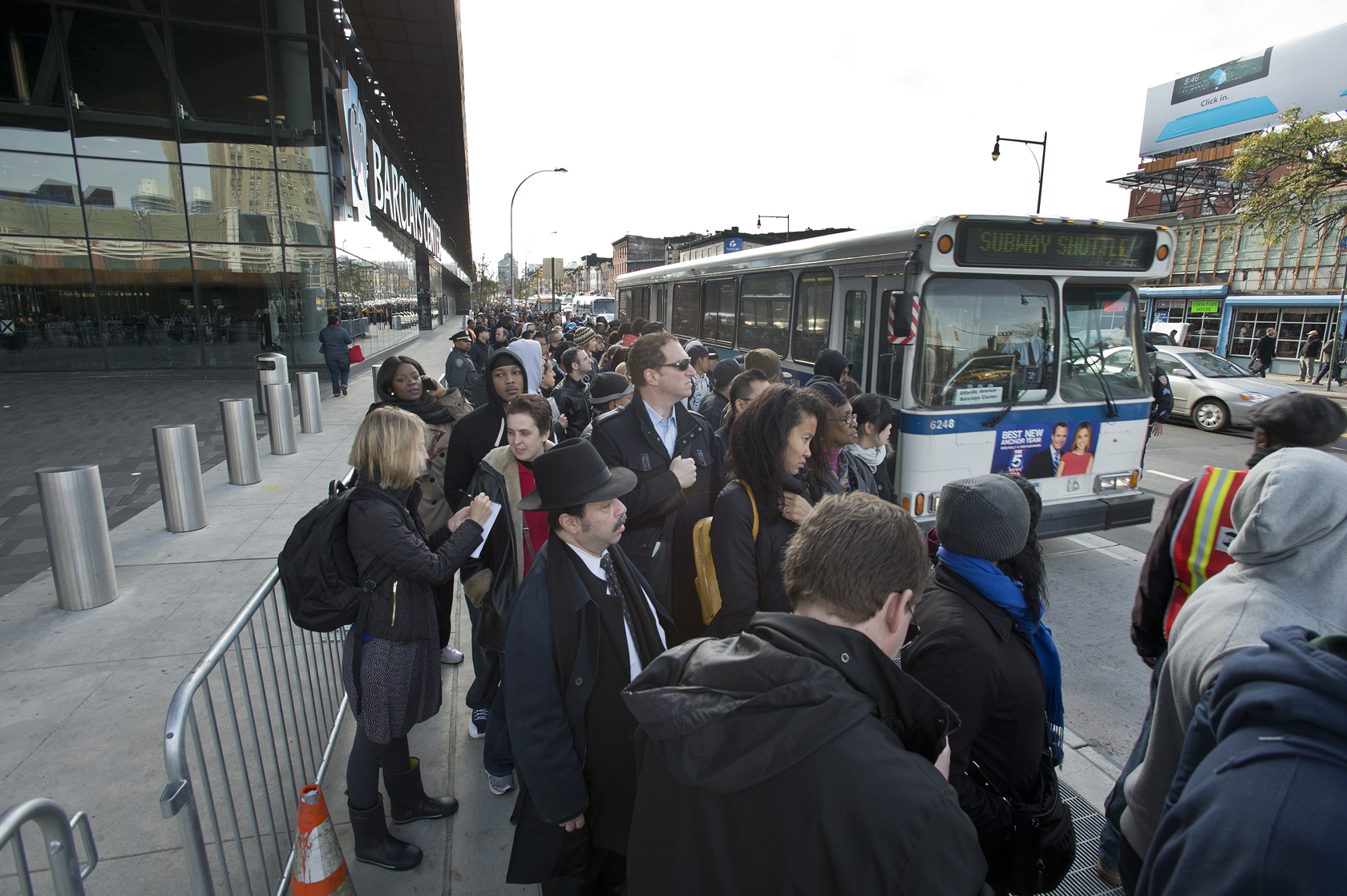
Further links listed by the Wikipedia page (not independently checked): - https://web.archive.org/web/20070929095548/http://mta.info/nyct/service/pdf/tfcur.pdf - https://web.archive.org/web/20050205132951/http://www.mta.info/nyct/service/subsrvnv.htm - https://web.archive.org/web/20050204005913/http://www.mta.info/nyct/service/acv_update.htm - https://web.archive.org/web/20050129034603/http://www.mta.info/nyct/service/acv_update.htm - https://www.nytimes.com/2001/12/17/nyregion/v-train-begins-service-today-giving-queens-commuters-another-option.html - https://www.nytimes.com/2000/12/02/nyregion/proposed-line-would-lighten-subway-crush.html Image rights Photograph description: On November 1, 2012, subway tunnels under the East River remained out of service after they were flooded during Hurricane Sandy. As a temporary means to allow people across the East River, 330 shuttle buses connected subway and LIRR customers at Barclays Center, MetroTech, and Hewes St. with destinations in Manhattan. Crews are working 24 hours a day to pump millions of gallons of seawater out the Creator: Metropolitan Transportation Authority of the State of New York. License: CC BY 2.0 (https://creativecommons.org/licenses/by/2.0). Original image page: https://commons.wikimedia.org/wiki/File%3ANYCB_4813_(8145509454).jpg. The image was resized for display; no other changes were made.