LGBTQ+ · San Francisco
Before the Castro Became Halloween’s Center, San Francisco’s Celebration Moved Across the City
San Francisco’s LGBTQ Halloween tradition traveled from the Tenderloin and North Beach to Polk Street before becoming a major Castro gathering.
By KLGBT News Desk ·
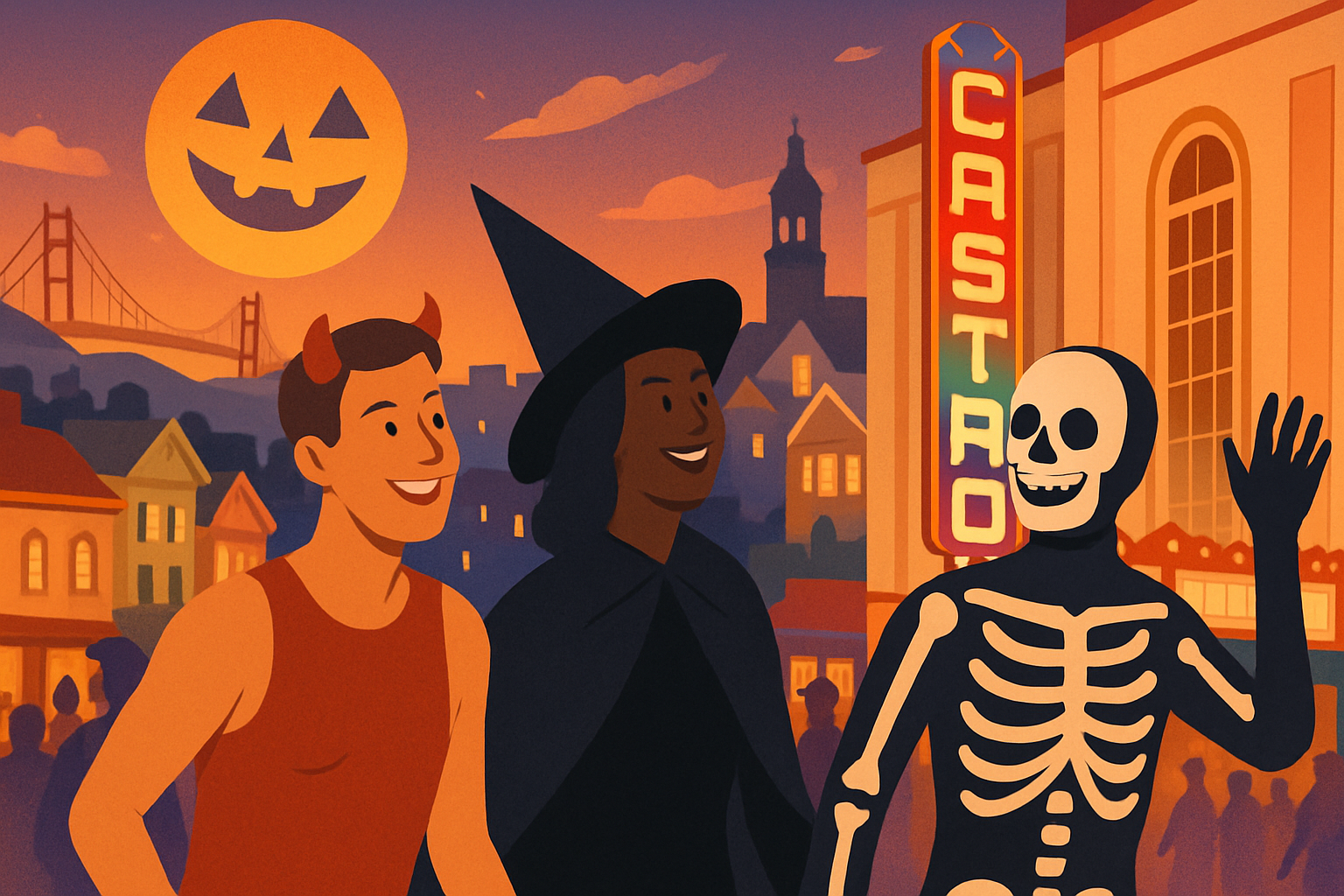
San Francisco’s LGBTQ Halloween history is also a record of the city’s changing queer geography. What became a huge Castro tradition began decades earlier, in smaller neighborhood celebrations and nightlife districts.
The earliest version of the event dates to the 1940s, when Halloween in the Castro was organized as a neighborhood costume contest. Over time, the celebration took on a different character. By the late 1970s, it had developed from a children’s occasion into a public expression of gay pride.
In the early 1960s, San Francisco’s gay Halloween activity was concentrated around bars in the Tenderloin. Those establishments had relocated there from North Beach, a neighborhood that remains associated with adult entertainment and nightlife. By the end of that decade, Grant Avenue in North Beach had become the gathering point.
The celebration moved again in 1970, this time to Polk Street in Polk Gulch, where it remained through 1978. That period included a confrontation in 1977, when people described in the historical record as gay bashers clashed with police. Officers used tear gas to break up the crowds.
By 1979, the center of San Francisco’s gay community had shifted to the Castro, and the Halloween celebration followed. The event grew into a large-scale street gathering known for elaborate and provocative costumes. Its reputation expanded beyond the city, eventually making it one of the most prominent Halloween celebrations in the United States.
The scale increased sharply over the following decades. By 2002, attendance had reached the hundreds of thousands, transforming a community-centered celebration into a massive public event. That growth also created major challenges for safety and crowd management.
In 2006, a mass shooting injured nine people, and San Francisco officials canceled the Halloween event. The decision marked a decisive break in the history of the gathering, which had evolved from a local costume contest into a nationally recognized LGBTQ celebration.
The story of Halloween in the Castro is therefore not only about costumes or nightlife. It traces the movement of queer public life through several San Francisco neighborhoods, from the Tenderloin and North Beach to Polk Street and finally the Castro. Each relocation reflected changes in where gay bars, social networks, and community visibility were concentrated. The event’s rise also shows how a celebration rooted in LGBTQ community could become so large that public safety became inseparable from its future.
Source and reuse information This backgrounder adapts factual material from “Halloween in the Castro” on Wikipedia: https://en.wikipedia.org/wiki/Halloween_in_the_Castro The adapted text is released under the Creative Commons Attribution-ShareAlike 4.0 International license (CC BY-SA 4.0): https://creativecommons.org/licenses/by-sa/4.0/. This story has not been independently reviewed or fact-checked.
Further links listed by the Wikipedia page (not independently checked): - https://web.archive.org/web/20070513000922/http://www.sfbg.com/entry.php?entry_id=4392&catid=4&volume_id=254&issue_id=312&volume_num=40&issue_num=48 - https://web.archive.org/web/20070927201302/http://www.sfbg.com/entry.php?entry_id=1410&catid=4 - https://web.archive.org/web/20061012102157/http://www.thesisters.org/sistory.html - https://query.nytimes.com/gst/fullpage.html?sec=travel&res=9C00EED91F31F934A3575AC0A961958260 - https://www.nytimes.com/2006/11/02/us/02fight.html?_r=1&oref=slogin - https://www.nytimes.com/2007/10/30/us/30gay.html?_r=1&oref=slogin Image rights Original illustrative artwork created from story keywords. It is illustrative, not a documentary photograph.