Culture · San Francisco
How ‘Milk’ Brought Harvey Milk’s San Francisco Story to the Screen
Gus Van Sant’s 2008 film revisits Harvey Milk’s life, political work and place in San Francisco history, with much of the production filmed on the streets and at locations connected to his legacy.
By KLGBT News Desk ·
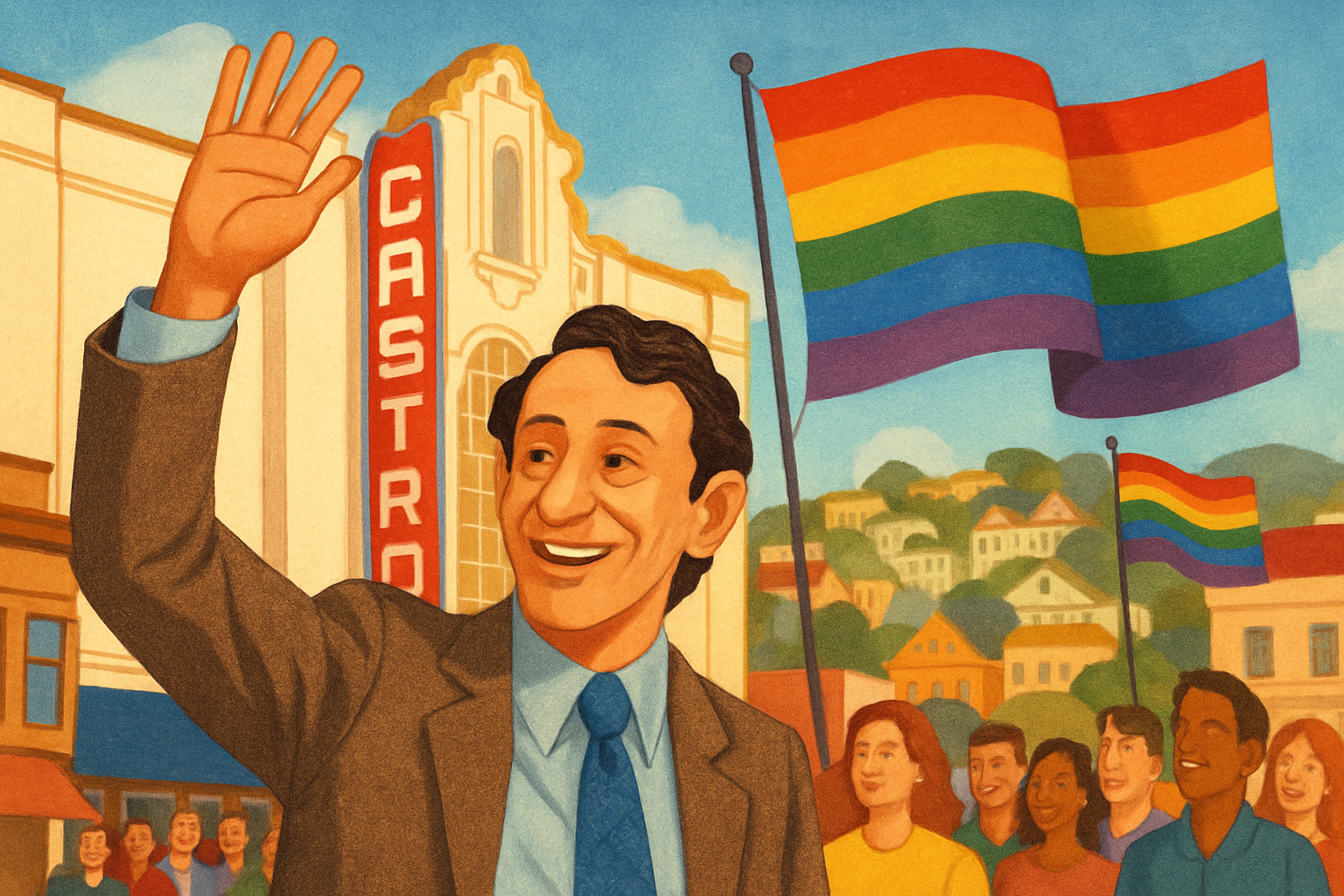
For San Francisco, “Milk” is more than a biographical film set in a recognizable city. Gus Van Sant’s 2008 drama presents the life of Harvey Milk, the gay rights activist and politician who became the first openly gay man elected to public office in California. Milk served on the San Francisco Board of Supervisors, making his political career a central part of the city’s LGBTQ+ history.
The film stars Sean Penn as Milk, with Emile Hirsch, Josh Brolin, Diego Luna and James Franco in supporting roles. Dustin Lance Black wrote the screenplay, which brought Milk’s public work and personal life to a wide film audience. Much of the production took place in San Francisco, including on Castro Street and at other locations tied to Milk’s story. Among them was the former Castro Camera storefront, connecting the production directly to a place associated with his life and work.
“Milk” was not the first major screen project about the activist. The 1984 documentary “The Times of Harvey Milk” examined his life and the aftermath of his assassination. That documentary was loosely based on Randy Shilts’s 1982 biography, “The Mayor of Castro Street.” It received the Academy Award for Best Documentary Feature for 1984 and a Special Jury Prize at the first Sundance Film Festival, among other honors.
Efforts to develop a dramatic film about Milk continued at various points after the documentary, but several proposed projects did not move forward. The feature film finally reached production in 2007 and was released the following year. Its San Francisco locations helped distinguish it from a story merely about the city: the streets and neighborhood spaces function as visible links to the political history the film depicts.
The movie received strong reviews from critics and recognition from film critics’ groups and guilds. It also earned $54.6 million worldwide. For local audiences, its lasting significance lies partly in the way it places an LGBTQ+ political figure within the physical landscape of San Francisco. Castro Street, in particular, is presented not simply as scenery, but as part of the historical setting surrounding Milk’s activism and public life.
By combining a nationally distributed feature film with locations familiar to San Franciscans, “Milk” connected the city’s LGBTQ+ history to a broader audience. Its relationship to the earlier documentary also shows how Milk’s story has continued to be interpreted across different forms of film, from historical documentary to dramatic biography.
Source and reuse information This backgrounder adapts factual material from “Milk (2008 American film)” on Wikipedia: https://en.wikipedia.org/wiki/Milk_(2008_American_film) The adapted text is released under the Creative Commons Attribution-ShareAlike 4.0 International license (CC BY-SA 4.0): https://creativecommons.org/licenses/by-sa/4.0/. This story has not been independently reviewed or fact-checked.
Further links listed by the Wikipedia page (not independently checked): - https://web.archive.org/web/20081221070202/http://www2.dailybulletin.com/ci_11257530 - https://viaf.org/viaf/184419032 - https://web.archive.org/web/20160618060332/http://www.c-e-m.org/wp-content/uploads/milk_production_notes.pdf - https://web.archive.org/web/20081205011935/http://www.nomilkforcinemark.com/ - https://web.archive.org/web/20150403003958/http://variety.com/2008/film/reviews/milk-7-1200472542/ - https://web.archive.org/web/20090102205252/http://www.metacritic.com/film/awards/2008/toptens.shtml Image rights Original illustrative artwork created from story keywords. It is illustrative, not a documentary photograph.