LGBTQ+ · San Francisco
How San Francisco’s Council on Religion and the Homosexual Created a New Kind of Dialogue
Founded in 1964, the San Francisco-based Council on Religion and the Homosexual brought clergy and homosexual activists together at a time when both religious institutions and LGBTQ communities were confronting widespread marginalization.
By KLGBT News Desk ·
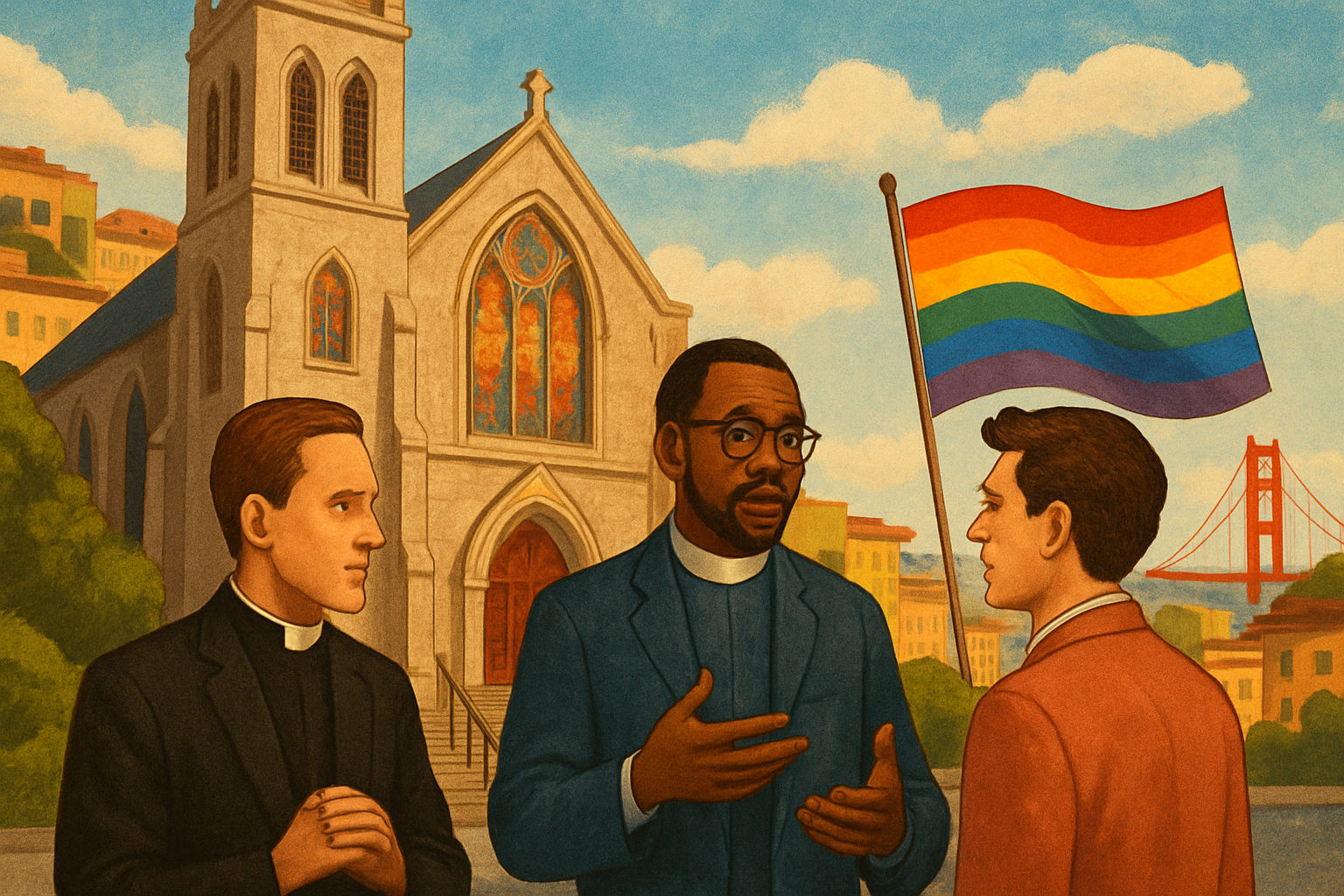
In 1964, San Francisco became the home of an organization that challenged the distance between religious institutions and the city’s homosexual community. The Council on Religion and the Homosexual, known as the CRH, was created to bring homosexual activists and religious leaders into conversation and to address the violence and oppression faced by homosexual people.
The organization grew out of Glide Memorial Methodist Church and the work of Daughters of Bilitis founders Phyllis Lyon and Del Martin. Its membership included representatives of several Protestant traditions, including Methodist, Episcopal, Lutheran, and United Church of Christ leaders. That combination reflected the CRH’s central idea: religious figures and homosexual activists could work together rather than remain separated by fear, stigma, or disagreement.
The Rev. Ted McIlvenna played an important role in bringing the groups together. McIlvenna worked with the Glide Urban Center, a private Methodist foundation in downtown San Francisco. As he witnessed the treatment of homosexual people, including the violence and social pressure directed at them, he sought a way for clergy to engage with the community more directly.
With support from the Methodist church, McIlvenna organized the Mill Valley Conference from May 31 through June 2, 1964. Sixteen Methodist, Protestant Episcopal, United Church of Christ, and Lutheran clergymen met with 13 leaders from the homosexual community. The gathering included members of Daughters of Bilitis, the San Francisco organization founded by Lyon and Martin.
The conference represented an early attempt to create sustained dialogue across lines that were often treated as immovable. For clergy, participation meant confronting the conditions experienced by homosexual people beyond the walls of their congregations. For activists, it created an opportunity to speak directly with religious leaders at a time when homosexuality was widely stigmatized.
The CRH’s formation also reflected broader changes taking place in the United States during the early 1960s. Progressive clergy were increasingly entering public life to support marginalized people, while homosexual activists were building organizations and seeking new ways to resist discrimination. San Francisco provided a setting where those efforts could meet.
Rather than treating religion and homosexual rights as inherently opposed, the Council on Religion and the Homosexual made cooperation its organizing purpose. Its founding connected a downtown Methodist center, established lesbian organizers, and leaders from multiple Protestant denominations. That coalition marked an important chapter in San Francisco’s LGBTQ history: a local effort to turn contact between communities into a deliberate form of social action.
Source and reuse information This backgrounder adapts factual material from “Council on Religion and the Homosexual” on Wikipedia: https://en.wikipedia.org/wiki/Council_on_Religion_and_the_Homosexual The adapted text is released under the Creative Commons Attribution-ShareAlike 4.0 International license (CC BY-SA 4.0): https://creativecommons.org/licenses/by-sa/4.0/. This story has not been independently reviewed or fact-checked.
Further links listed by the Wikipedia page (not independently checked): - https://www.sfgate.com/bayarea/article/Donald-Stewart-Lucas-gay-rights-pioneer-He-2586102.php - https://digitalcommons.law.scu.edu/facpubs/277 - https://doi.org/10.2307%2F1073382 - https://www.jstor.org/stable/1073382 Image rights Original illustrative artwork created from story keywords. It is not a documentary photograph.