LGBTQ+ · San Francisco
Remembering San Francisco’s White Night Riots
On May 21, 1979, outrage over Dan White’s lenient conviction for killing Mayor George Moscone and Supervisor Harvey Milk erupted into violence at City Hall.
By KLGBT News Desk ·
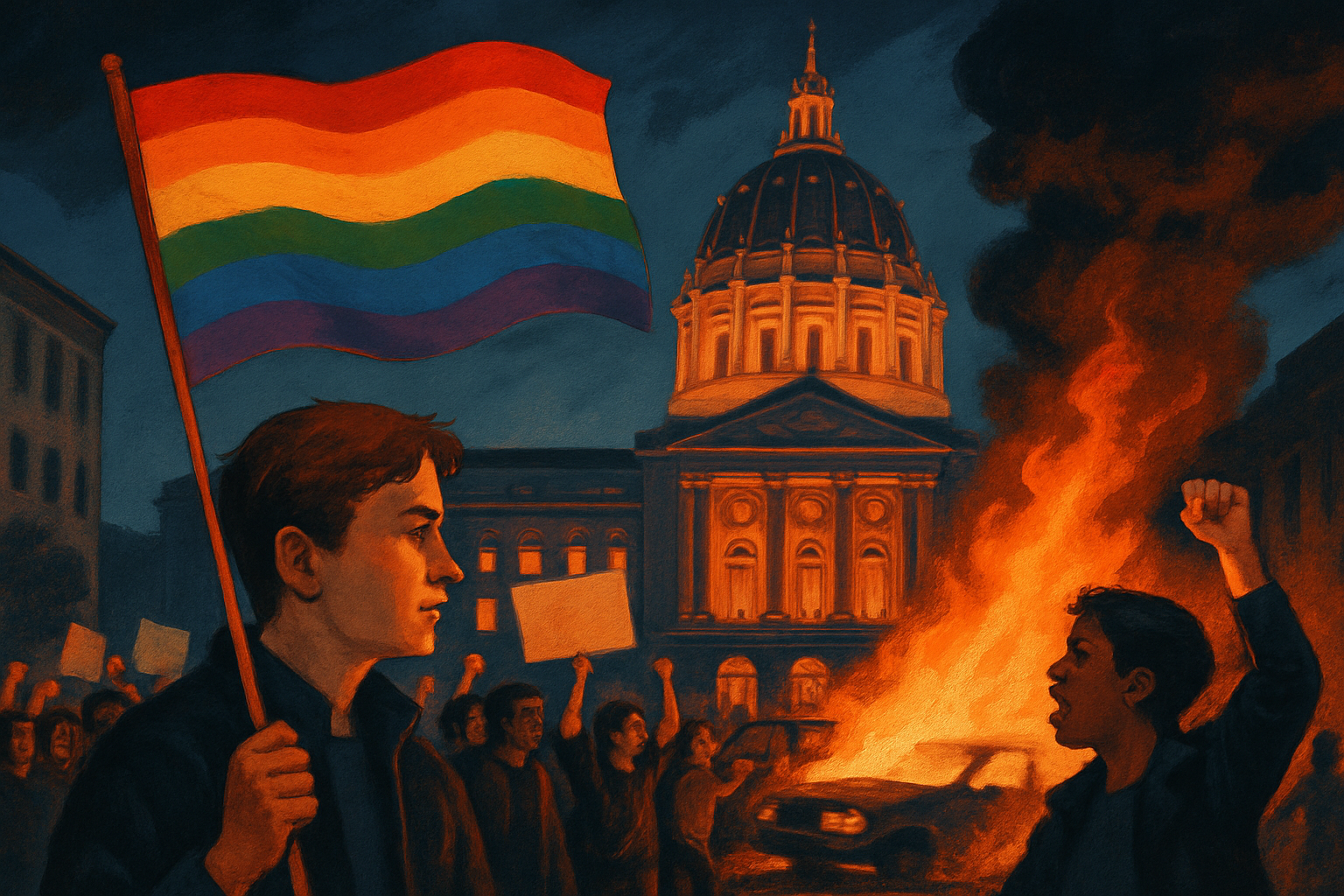
San Francisco’s White Night riots began with a courtroom decision and unfolded in the heart of the city’s LGBTQ community.
On May 21, 1979, Dan White was convicted of voluntary manslaughter for killing Mayor George Moscone and Harvey Milk, a member of the San Francisco Board of Supervisors. Voluntary manslaughter was the least serious conviction available for the killings. The announcement of that outcome, widely viewed as lenient, provoked anger among gay San Franciscans and others who had followed the case.
Milk’s death carried particular weight. He had been one of the first openly gay elected officials in the United States, and his position on the Board of Supervisors made his assassination a defining trauma for the city’s LGBTQ community. Moscone, the city’s mayor, was also killed in the same attack.
The first response on White Night was a peaceful march through the Castro district. The crowd then moved to San Francisco City Hall, where the demonstration turned violent. The events produced extensive property damage at City Hall and in nearby areas, amounting to hundreds of thousands of dollars. Police officers were injured as well.
The unrest also reflected a longer conflict between San Francisco’s gay community and the San Francisco Police Department. White’s background as a former police officer deepened the community’s anger toward the department and shaped how many people understood the night’s events. For LGBTQ San Franciscans, the violence was not simply a reaction to one verdict; it emerged from accumulated distrust and the shock of losing a prominent elected advocate.
The White Night riots are often remembered as one of the most significant episodes in the history of San Francisco’s LGBTQ movement. The reaction was described as the most violent uprising by gay Americans since the 1969 Stonewall riots in New York City. That comparison places the events within a broader history of resistance to institutions seen as hostile or unresponsive to gay people.
More than four decades later, the night remains tied to two parts of San Francisco’s civic memory: the promise represented by Milk’s election and the fury that followed his killing. White Night is therefore both a story about a particular criminal verdict and a record of the profound tensions between the city’s LGBTQ community, its political leadership, and law enforcement in 1979.
Source and reuse information This backgrounder adapts factual material from “White Night riots” on Wikipedia: https://en.wikipedia.org/wiki/White_Night_riots The adapted text is released under the Creative Commons Attribution-ShareAlike 4.0 International license (CC BY-SA 4.0): https://creativecommons.org/licenses/by-sa/4.0/. This story has not been independently reviewed or fact-checked.
Further links listed by the Wikipedia page (not independently checked): - https://archive.org/details/ssfWhitent1 - https://www.washingtonpost.com/archive/politics/1979/05/12/anti-gay-sentiments-turn-violent-in-aftermath-of-moscone-milk-killings/adb57605-5622-4c2e-833d-db051d47d622 - https://www.pbs.org/wgbh/pages/frontline/aids/interviews/jones.html - https://scholar.google.ca/scholar_case?case=11045190972502075486 - https://web.archive.org/web/20090430043558/http://voterguide.sos.ca.gov/past/2008/general/title-sum/prop8-title-sum.htm - https://web.archive.org/web/20090524010502/http://sfist.com/2009/05/20/newsom_asks_court_to_delay_prop_8_r.php Image rights Original illustrative artwork created from story keywords. It is illustrative, not a documentary photograph.