LGBTQ+ · San Francisco
The San Francisco Bar Case That Challenged a License Suspension
In 1951, California’s highest court ruled that the presence of gay patrons at San Francisco’s Black Cat was not, by itself, grounds to suspend the bar’s liquor license.
By KLGBT News Desk ·
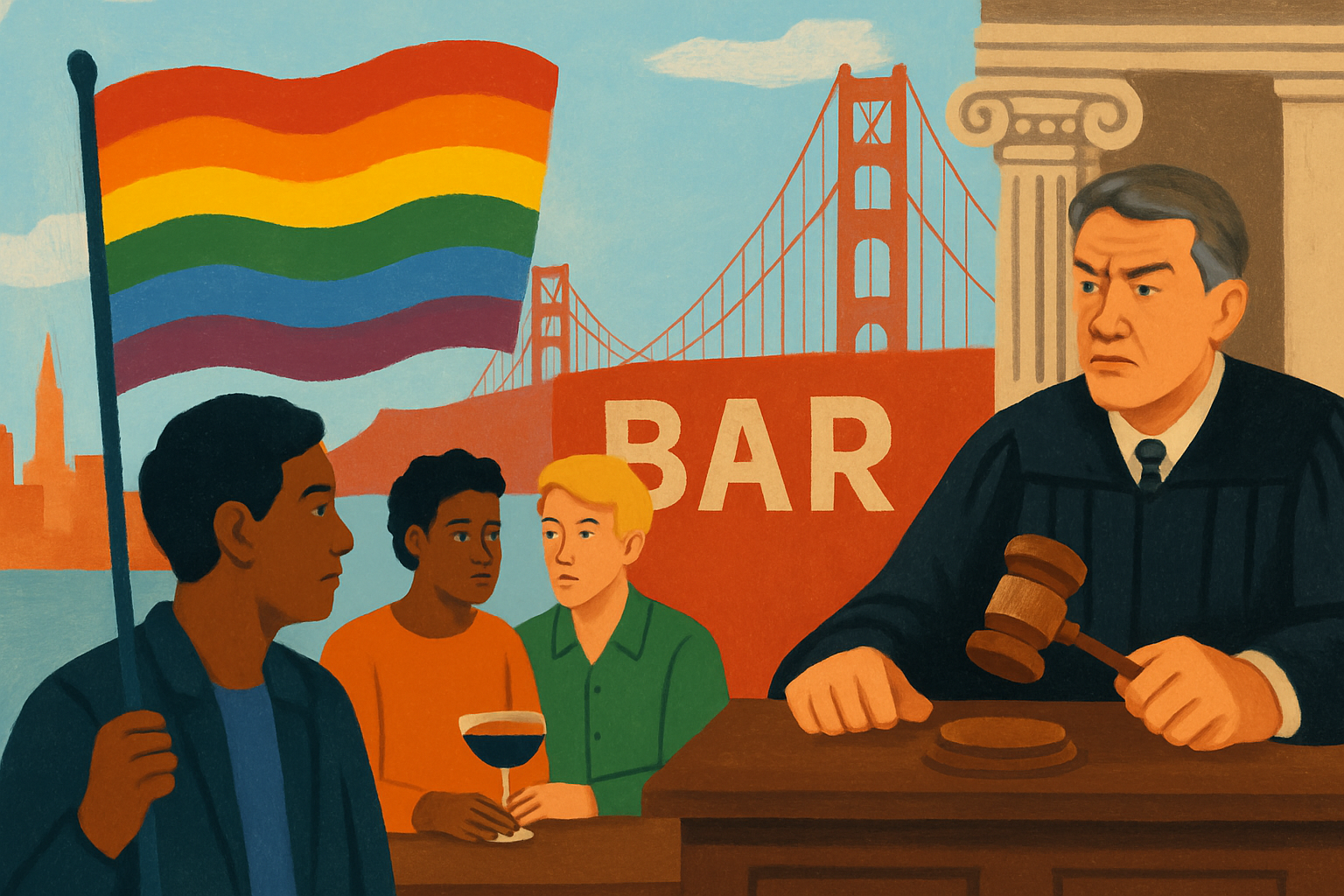
Long before LGBTQ+ rights victories became a regular part of the legal landscape, a San Francisco bar owner took his fight to California’s highest court—and won.
The case, Stoumen v. Reilly, grew out of the Black Cat, a bohemian bar and restaurant in San Francisco. In 1949, the California State Board of Equalization suspended the establishment’s liquor license after accusing it of allowing people described by the board as having “known homosexual tendencies” to gather there.
Sol Stoumen, the Black Cat’s owner, challenged the suspension. His position was straightforward: the perceived gender expression or sexuality of some customers was not itself illegal conduct. The case placed a basic question before the California Supreme Court: Could the government punish a bar simply because gay people were among its patrons?
On August 28, 1951, the court ruled for Stoumen. The justices determined that patronage by gay people, without evidence that illegal or immoral acts had taken place on the premises—or that customers went there for such purposes—was not enough to justify the license suspension.
All seven justices agreed with the decision. The ruling allowed Stoumen to retain his business and liquor license, and it rejected the idea that a bar’s association with gay customers alone established a legal violation.
The decision did not erase the hostility LGBTQ+ people faced, nor did it create a broad modern prohibition on discrimination. Its significance was narrower and, at the same time, important: In a period when officials could treat the gathering of gay people as evidence of wrongdoing, the court required more than the mere presence of those patrons before the state could take action against a business.
For San Francisco, the case placed a local gathering place at the center of an early civil-rights victory. The Black Cat’s license fight showed how a business dispute could become a test of whether LGBTQ+ people could meet in public without their presence alone being treated as unlawful.
Stoumen v. Reilly is widely regarded as one of the earliest landmark victories for gay civil rights in the United States. Its core principle was limited but consequential: A government agency could not use the simple fact that gay people gathered at a bar as sufficient proof that the business had violated the law.
Source and reuse information This backgrounder adapts factual material from “Stoumen v. Reilly” on Wikipedia: https://en.wikipedia.org/wiki/Stoumen_v._Reilly The adapted text is released under the Creative Commons Attribution-ShareAlike 4.0 International license (CC BY-SA 4.0): https://creativecommons.org/licenses/by-sa/4.0/. This story has not been independently reviewed or fact-checked.
Further links listed by the Wikipedia page (not independently checked): - https://scocal.stanford.edu/opinion/stoumen-v-reilly-29515 - https://caselaw.findlaw.com/court/ca-supreme-court/1800289.html - https://sunnysidehistory.org/2018/10/18/george-r-reilly-and-first-lgbt-legal-victory/ - https://daily.jstor.org/gay-bars-and-gay-rights/ Image rights Original illustrative artwork created from story keywords. It is illustrative, not a documentary photograph.