LGBTQ+ · San Francisco
When San Francisco’s Gay Olympic Games Reached the Supreme Court
A 1987 Supreme Court ruling gave the U.S. Olympic Committee authority to challenge San Francisco’s use of “Olympic” in the name of a gay sporting event, leading organizers to adopt the name Gay Games.
By KLGBT News Desk ·
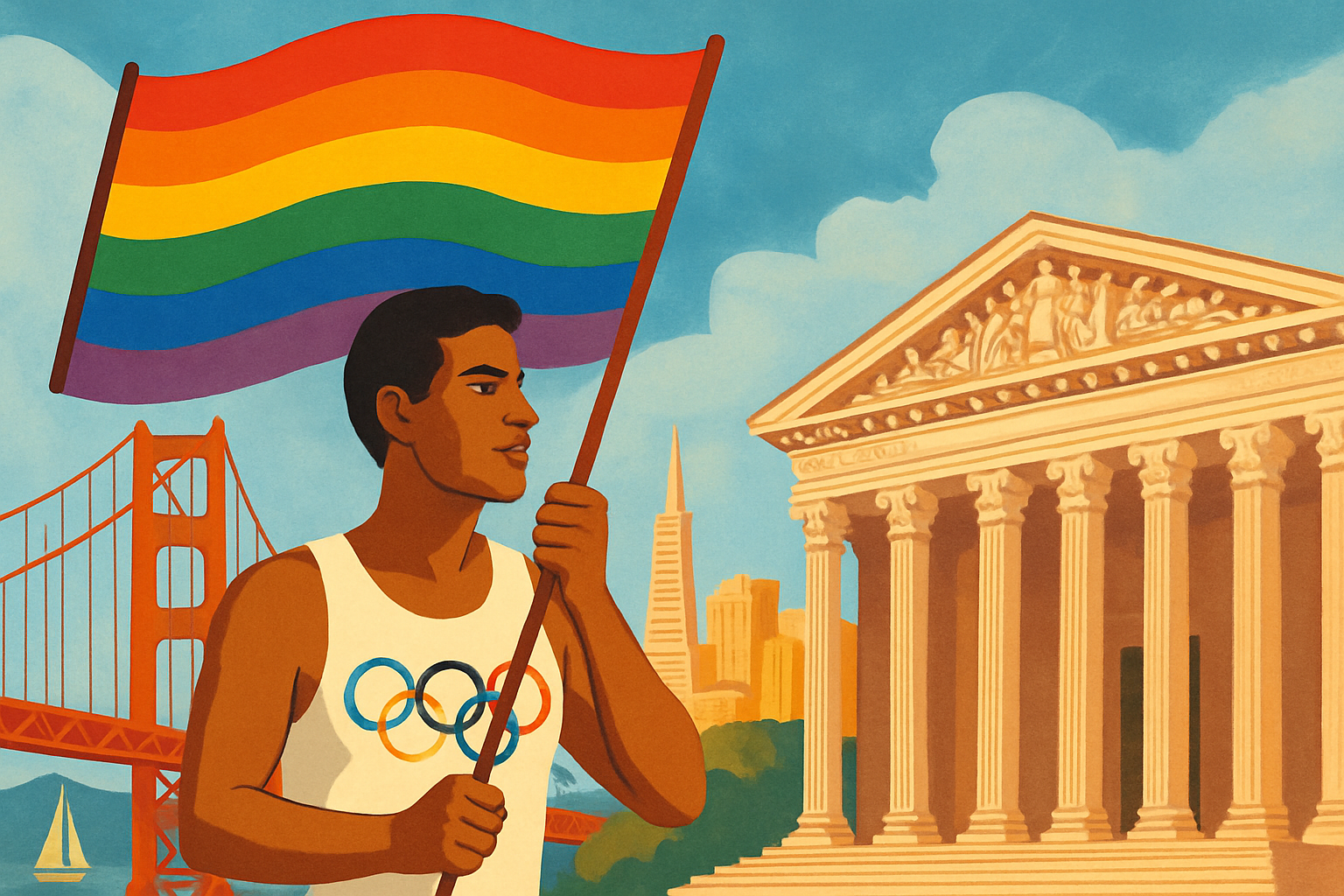
A dispute over the name of a San Francisco sporting event became a major Supreme Court case in 1987, testing the relationship between LGBTQ+ expression and trademark protection.
San Francisco Arts & Athletics, Inc. sought to organize a competition called the Gay Olympic Games. The United States Olympic Committee, or USOC, objected to the event’s name and pursued an injunction to prevent the organizers from using “Olympic.” The conflict ultimately reached the Supreme Court in San Francisco Arts & Athletics, Inc. v. United States Olympic Committee, a decision reported at 483 U.S. 522.
At the center of the case was the Amateur Sports Act of 1978. The law granted the USOC authority to regulate use of the word “Olympic.” San Francisco Arts & Athletics argued that applying that authority to its event violated the First Amendment. The organization’s position framed the name as a form of expression connected to the event’s identity and purpose.
The Supreme Court rejected that First Amendment argument. In doing so, the Court upheld the USOC’s ability under the law to challenge the use of “Olympic” in this context. The ruling did not end the sporting event itself, but it did require a change in its name.
San Francisco Arts & Athletics renamed the event the Gay Games, a title that reflected its LGBTQ+ focus without using the protected word at issue in the lawsuit.
The case also emerged from a broader debate about how amateur sports were organized in the United States. Before the federal government became involved, the Amateur Athletic Union coordinated U.S. teams. The AAU faced criticism for rules that restricted participation, including policies that barred women from some running events and excluded runners who had competed in events involving a shoe-company-sponsored athlete. Congress adopted the Amateur Sports Act in that larger context.
For San Francisco, the case remains a notable example of a local LGBTQ+ organization confronting a national sports institution and a federal statute. It also illustrates a legal tension that can arise when expressive names overlap with trademark rights. The Supreme Court’s decision recognized the USOC’s statutory control over “Olympic,” while the renamed Gay Games preserved the event’s underlying identity and purpose.
The outcome made the name itself the legal battleground. Although the organizers could not continue using “Gay Olympic Games,” the event continued under a new name: the Gay Games.
Source and reuse information This backgrounder adapts factual material from “San Francisco Arts & Athletics, Inc. v. United States Olympic Committee” on Wikipedia: https://en.wikipedia.org/wiki/San_Francisco_Arts_%26_Athletics,_Inc._v._United_States_Olympic_Committee The adapted text is released under the Creative Commons Attribution-ShareAlike 4.0 International license (CC BY-SA 4.0): https://creativecommons.org/licenses/by-sa/4.0/. This story has not been independently reviewed or fact-checked.
Further links listed by the Wikipedia page (not independently checked): - https://supreme.justia.com/us/483/522/case.html - https://news.google.com/newspapers?id=v7pJAAAAIBAJ&sjid=Kh0NAAAAIBAJ&pg=914,3441203&dq=san+francisco+arts+%26+athletics+inc&hl=en - https://www.nytimes.com/1987/06/26/us/supreme-court-roundup-justices-uphold-us-panel-s-ban-against-gay-olympics-title.html - https://www.law.cornell.edu/uscode/text/36/220506- - https://web.archive.org/web/20110715224248/http://www.teamusa.org/about-usoc/usoc-general-information/olympic-symbols-marks-and-terminology-guidelines - https://supreme.justia.com/cases/federal/us/483/522/ Image rights Original illustrative artwork created from story keywords. It is illustrative, not a documentary photograph.