LGBTQ+ · Seattle
Before the Double Header, The Casino Made Room for Queer Dancing in Pioneer Square
In 1930s Seattle, The Casino offered gay men and lesbians a place to dance, socialize, and build community in a city where same-sex dancing was not broadly permitted.
By KLGBT News Desk ·
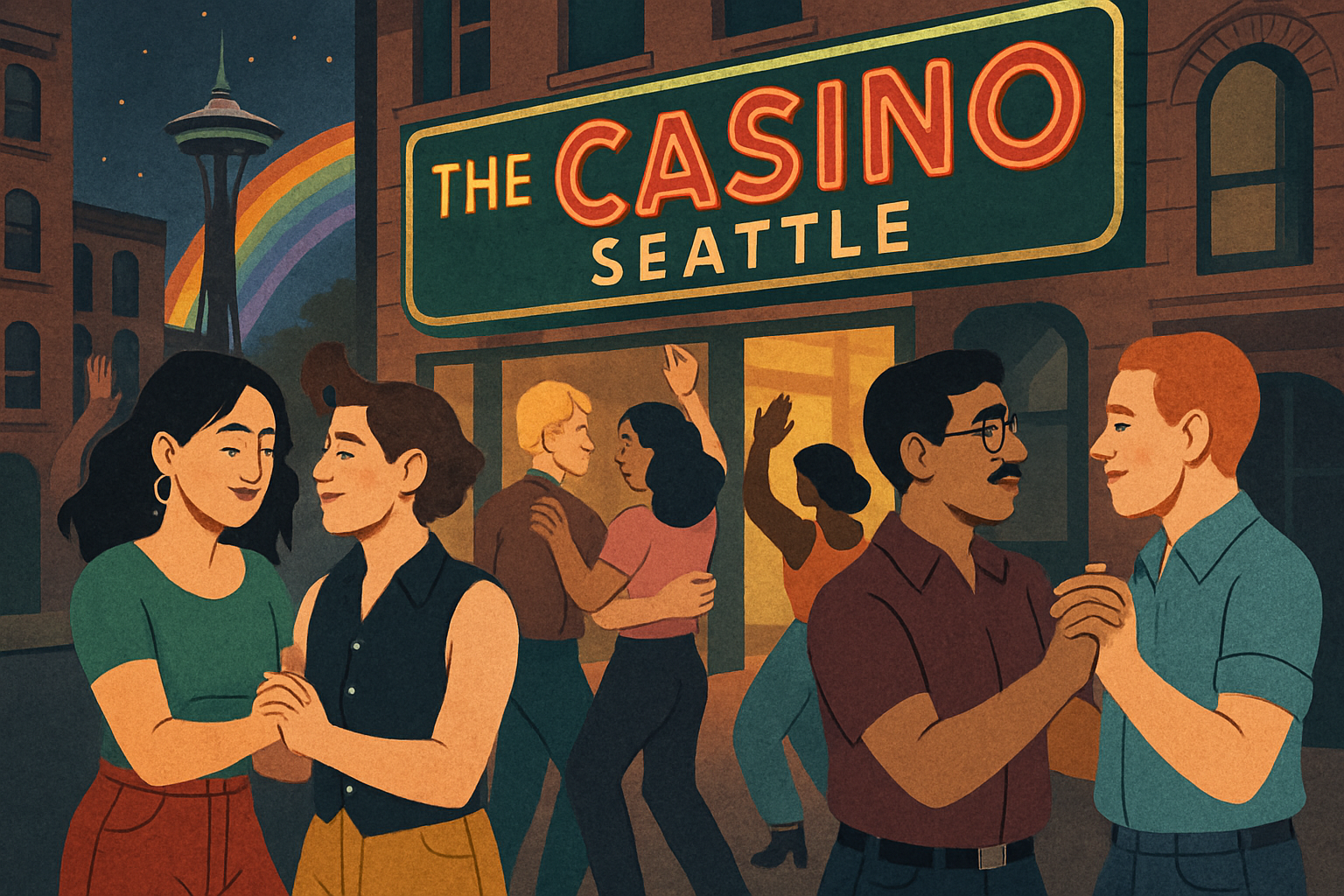
Long before Seattle’s LGBTQ+ nightlife became a visible part of the city’s cultural landscape, Pioneer Square was home to a venue that quietly made space for queer social life. The Casino opened in 1930 in the basement of a building later associated with The Double Header, which arrived in 1934.
The club combined several kinds of gathering places under one roof. It operated as a dance club, café, pool hall, and card room, giving patrons more than one reason to spend an evening there. Its location was the former site of the People’s Theater, which had operated from 1890 to 1904.
The Casino was run by John and Margaret Delevitti, a heterosexual couple described as supportive of gay people in Seattle. The venue became known as one of the West Coast establishments most welcoming to gay and lesbian customers. It also developed a strong following among drag queens, helping make it an important part of the city’s early queer nightlife history.
At the time, men dancing together was not widely accepted or permitted in public venues. The Casino nevertheless allowed same-sex couples to dance. According to the historical account, the club paid local police officers, an arrangement that helped it continue offering a freedom unavailable in many other spaces.
Word about the venue circulated through an informal network that connected gay and lesbian patrons with nightlife options. That underground flow of information helped The Casino gain a reputation as a speakeasy-like gathering place. Its appeal came not only from dancing, but from the possibility of meeting other people in an environment that was more accepting than much of the surrounding city.
The club’s story also shows how queer community spaces could depend on relationships across lines of identity. The Delevittis were not themselves a same-sex couple, but their management helped sustain a venue where gay men, lesbians, and drag performers could socialize. The Casino’s openness existed within limits: public acceptance remained narrow, and same-sex dancing was not yet broadly legalized.
Today, the site’s history places The Casino within a longer Pioneer Square tradition of nightlife and gathering. Before later landmarks became associated with Seattle’s LGBTQ+ community, The Casino provided a place to dance, talk, play games, and find one another. Its legacy is a reminder that queer history is often preserved not only in major institutions, but also in clubs that offered community before such spaces could operate openly.
Source and reuse information This backgrounder adapts factual material from “The Casino (Seattle)” on Wikipedia: https://en.wikipedia.org/wiki/The_Casino_(Seattle) The adapted text is released under the Creative Commons Attribution-ShareAlike 4.0 International license (CC BY-SA 4.0): https://creativecommons.org/licenses/by-sa/4.0/. This story has not been independently reviewed or fact-checked.
Further links listed by the Wikipedia page (not independently checked): - https://historylink.org/File/1167 - https://www.thestranger.com/visual-art/2017/10/11/25457501/the-indigenous-family-that-found-refuge-in-an-old-seattle-gay-bar - https://www.seattlemet.com/articles/2019/6/27/seattle-s-gay-bar-scene-is-changing-and-that-s-a-good-thing - https://books.google.com/books?id=HCsfDAAAQBAJ&pg=PA305 - https://web6.seattle.gov/DPD/HistoricalSite/QueryResult.aspx?ID=-768675463 - https://www.arcgis.com/apps/MapSeries/index.html?appid=594c28fb10b84bbda0545a2846fb4d1b Image rights Original illustrative artwork created from story keywords. It is illustrative, not a documentary photograph.